
The Portuguese real estate market attracts more and more foreign buyers each year, and fishing houses hold a special place in this dynamic. These coastal properties, often located in historic seaside villages, combine an still accessible entry price with a potential for appreciation linked to tourism pressure and the scarcity of land by the sea.
The Portuguese regulatory framework imposes no nationality restrictions on purchases, the main requirement being the acquisition of a NIF (tax identification number).
Total cost of owning a coastal property in Portugal
Content that promotes the purchase of a fishing house almost always focuses on the acquisition price. The charm of the whitewashed facades, the proximity to the ocean, the lower entry ticket compared to premium Algarve. What they leave unsaid is the actual cost of ownership over five or ten years.
An old seaside house faces physical constraints that a city-center apartment does not. Corrosion, humidity, mold, and insufficient ventilation form the recurring quartet of maintenance issues. The thick stone walls, typical of fishing constructions, retain moisture if ventilation has not been reconsidered during a renovation.
Before signing, one must therefore think in terms of total cost. The displayed price is just a fraction of the equation. The roof, the woodwork exposed to sea spray, the anti-humidity treatment of the interior walls, the electrical compliance: these items can represent a significant part of the total budget for an unrenovated old property.
Those who decide to buy a fishing house in Portugal benefit from having a comprehensive assessment of the building’s condition done before making any offer, including a humidity check and an estimate of the necessary compliance works.
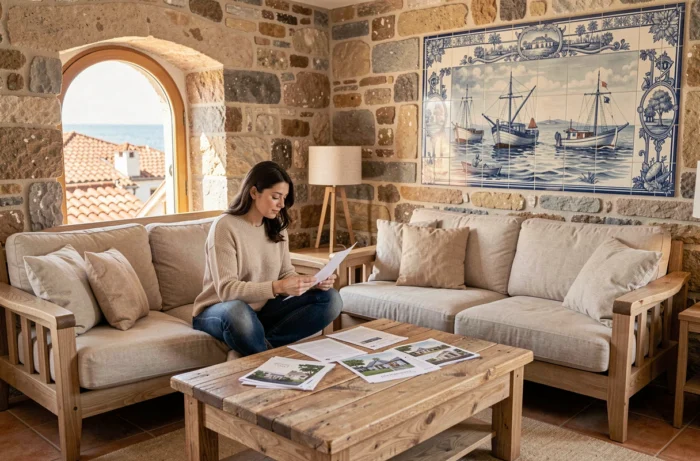
Real estate appreciation: not all coastal municipalities in Portugal follow the same logic
Referring to the Portuguese coastline as a homogeneous market is a common mistake. The same stretch of coast can juxtapose premium municipalities and significantly more accessible areas, with very different price dynamics.
This discrepancy creates two distinct investment profiles:
- Premium areas (Lagos, Loulé, Cascais) offer high liquidity and an international clientele, but a lower gross rental yield relative to the purchase price.
- Intermediate areas (certain municipalities in the coastal Alentejo, the west coast above Lisbon) present a more marked potential for appreciation, with a higher risk of rental vacancy off-season.
- Fishing villages still preserved from mass tourism offer the lowest prices, but resale may be slower due to a lack of structured demand.
The choice of municipality therefore determines the yield profile. A fishing house to renovate in a little-known village is not the same investment as a renovated property in an established resort.
Mixed use: second home and seasonal rental in Portugal
Fishing houses are increasingly presented as mixed-use products. The buyer is no longer just a retiree looking for a second home: they are balancing personal use and seasonal rental to cover part of the expenses.
This balancing act changes the nature of the investment. A house occupied four months a year and rented out the rest of the time must meet different requirements than a pure vacation residence. The interior layout, the capacity, the proximity to shops and beaches, the ease of access from an airport: these criteria become profitability parameters.
Regulatory constraints for seasonal rentals
Portugal regulates short-term rentals through a licensing system (Alojamento Local). Obtaining this license is a prerequisite for any legal tourist rental. Municipalities can restrict or suspend the issuance of new licenses in areas deemed saturated.
For an old fishing house, compliance with safety and habitability standards may require renovations. The license notably requires a valid habitation permit (licença de utilização), which is not always the case for very old properties.

Investor profile and limits to know before buying
The Portuguese coastal real estate has seen a significant increase in recent years. These dynamics attract, but they describe a market that has already risen considerably.
Several factors support demand: the absence of nationality restrictions for foreign buyers, a favorable climate, limited supply on the coast, and the country’s tax appeal despite recent adjustments to the non-habitual resident status.
Other elements call for caution:
- The rise in prices mechanically reduces the gross rental yield for new entrants.
- The maintenance of an old property by the sea represents a significant recurring expense.
- The resale of a fishing house in a little touristy village may take time.
- Regulatory changes regarding seasonal rentals can alter the profitability equation.
Investing in a fishing house in Portugal works better as a long-term heritage project than as a short-term speculative operation. The buyer who plans to use the property, gradually renovate it, and rent it out occasionally is in a stronger position than one who relies solely on capital appreciation.
The Portuguese market remains open and transparent for a foreign buyer, with moderate transaction fees and a relatively simple purchasing procedure once the NIF is obtained. The real variable, for a fishing house, remains the condition of the building and the exact location of the property, two factors that make all the difference between a profitable investment and a maintenance pit.