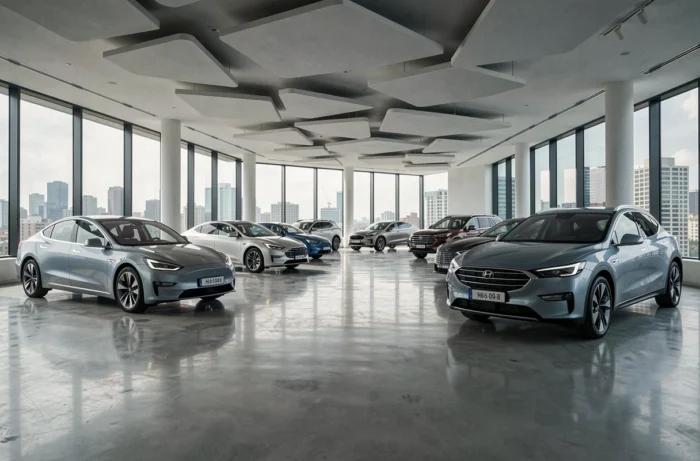
The French automotive market is undergoing a rapid restructuring phase. Between the rise of electric vehicles in the new segment, a used market that is out of sync, and industrial alliances reshaping the power dynamics among manufacturers, changes are happening on multiple fronts simultaneously. Keeping up with automotive industry news requires untangling these parallel dynamics, which do not always converge.
Used Electric Vehicles: A Market Taking Off Out of Sync with Thermal Used Cars
Most analyses focus on new electric vehicle registrations. The used electric segment tells a different story, one that is more revealing of the actual maturity of the transition.
By the second quarter of 2026, the market for used electric cars surpasses 70,000 transactions, an increase of over 40% compared to the previous quarter. This figure is all the more striking as the overall used market, across all types of engines, is declining during the same period.
This discrepancy can be explained by the conjunction of two phenomena. On one hand, the first electric vehicles sold in volume (Renault Zoé, Peugeot e-208, Tesla Model 3) are reaching the end of their first ownership cycle, increasing supply. On the other hand, the gradual decrease in prices in the used segment is making these models accessible to buyers who were not willing to purchase new ones.
The French government has implemented various measures to support this transition: CEE bonus, mandatory display of battery health status, enhanced assistance for certain professions. Field reports vary on the actual effectiveness of these measures, particularly in rural areas where the network of charging stations remains uneven.
Professionals who continuously aggregate automotive news allow for tracking these developments over time. Several quarterly barometers, including one published jointly by Mobilians and Avere-France, provide reliable benchmarks for assessing market trends. Visiting the homepage of Le Blog Auto Mag offers an entry point to this type of regular sector monitoring.

Market Share of New Electric Vehicles in France: What the One-Third Threshold Reveals
In the new segment, 100% electric cars reached a symbolic milestone during the summer of 2026. According to the Avere-France barometer from July 2026, electric vehicles sustainably exceed one-third of registrations of passenger cars, with a share fluctuating between one-third and nearly 40% depending on the month.
The significant fact is not just in the volume. The structure of demand has changed. Acquisitions of electric vehicles are now almost balanced between private individuals and professional buyers. Until recently, corporate fleets and long-term rentals drove most of the growth. This rebalancing indicates that the transition now relies on all distribution channels.
This shift raises concrete questions for distribution networks. A dealer whose used stock was composed of 80% thermal vehicles three years ago must rethink its stock rotation, workshop skills, and battery buyback management. The available data does not yet allow for precise measurement of the cost of this adaptation for medium-sized distribution groups.
Alliances Among Automakers: Honda-Nissan and Industrial Restructuring
While the French market evolves on the demand side, supply is restructuring on a global scale. The agreement between Honda and Nissan to create a joint venture dedicated to electronic control units illustrates a fundamental shift.
These two Japanese manufacturers are pooling the development of software components intended for next-generation vehicle architectures. The stakes go beyond mere cost reduction. It is about catching up on technological delays against Chinese manufacturers and Tesla, who have integrated software at the core of their model designs for several years.
What This Alliance Says About Global Power Dynamics
China now accounts for an increasing share of global electric vehicle production. European and Japanese manufacturers are responding with alliance strategies rather than isolated investments. However, these partnerships remain fragile: Volkswagen’s restructuring plan, which includes an additional 50,000 job cuts and a margin target of 9% by 2030, shows that internal adjustments can be as complex as external negotiations.
For industry observers, these strategic movements are just as significant as monthly sales figures. A failed alliance or a poorly calibrated social plan can alter the availability of models in France within two to three years.
Diesel, Gasoline, Hybrid: Where Do We Stand on the Coexistence of Powertrains in France
The rise of electric vehicles does not mean the instantaneous disappearance of thermal powertrains. The used market, which represents a transaction volume far greater than new, remains largely dominated by gasoline and diesel. A slight uptick in diesel and gasoline was even observed in July 2026 in the used segment.
This coexistence creates an ambiguous situation for automotive professionals:
- Workshops must maintain skills on thermal engines while training technicians in high voltage and battery management systems.
- Distribution networks are simultaneously managing stocks of vehicles whose depreciation cycles differ radically depending on the powertrain.
- Individuals selling a recent diesel face an accelerated depreciation due to traffic restrictions in low-emission zones, without the used electric market being mature enough to absorb all the replacement demand.
Thus, automotive sector trends cannot be reduced to a linear trajectory toward full electrification. The current period resembles more of a transition phase where multiple market logics coexist, with different timelines depending on segments (new or used), territories (urban or rural), and buyer profiles.
Regular monitoring of automotive news, whether through Avere-France’s quarterly barometers, Mobilians data, or specialized press, remains the most reliable way to anticipate upcoming shifts in a market that is far from finished transforming.