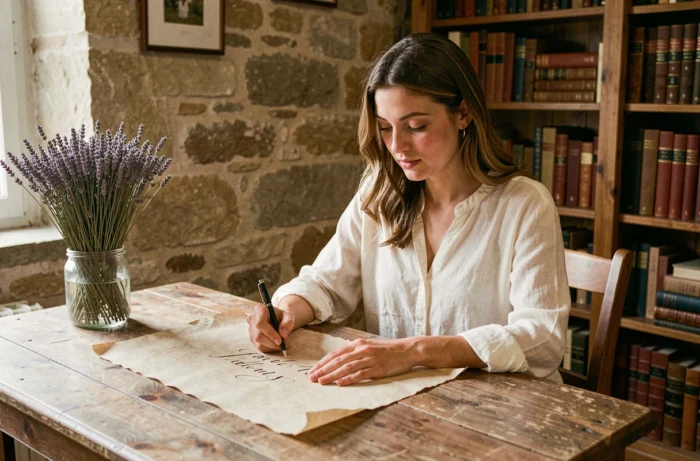
Clara is one of those names that is immediately recognizable, with no hesitation about pronunciation or gender. Two syllables, a clear sound, and an etymology that directly refers to light. The name comes from the Latin clarus, which means clear or bright. This linguistic transparency partly explains why it has endured through the centuries without losing its charm.
Clara and the Latin clarus: a name rooted in the Roman language
Before becoming a name, clarus was a common adjective in Latin. It described what is bright, visible, or famous. The Romans used it to describe both a clear sky and to praise the reputation of a speaker.
The transition from adjective to feminine name happened naturally. The form Clara, the feminine variation of clarus, circulated throughout the Mediterranean basin from late antiquity. This explains why the name sounds right in French, Spanish, Italian, or Portuguese: it shares the same Latin root with all these languages.
To delve deeper into the meaning and origin of the name Clara, we see that this Latin lineage remains the foundation of all the name’s variants across Europe.
Saint Clare of Assisi: the medieval turning point for the name Clara
While Clara already existed in antiquity, it gained a new dimension in the 13th century. Saint Clare of Assisi, a contemporary and disciple of Saint Francis, founded the order of the Poor Clares. Her spiritual influence far exceeds Italy.
Clare of Assisi embodies moral clarity and spiritual rigor. She chooses radical poverty and refuses any material compromise. Her radiance transforms the name into a symbol of purity and determination. The feast of Saint Clare is celebrated on August 11, a date that remains associated with the name in the liturgical calendar.
After her canonization, the name spread throughout Christian Europe. Families see it as a tribute to the saint, but also as a name carrying positive values: light, transparency, constancy.
Popularity of Clara in France: a peak followed by slow erosion
Have you noticed that Clara has been frequently heard in playgrounds for about twenty years? It’s no coincidence. The name saw a strong surge in France in the 2000s, driven by the trend of short names ending in -a.
Since the beginning of the 2020s, Clara has begun a gradual decline. Newer names like Léna, Mila, or Nora are capturing some of the allocations. Data published on the national public data platform confirms this trend.
This decline masks an interesting geographical reality. Clara holds up better in certain areas:
- The departments in the west and south of France, where names of Latin origin or with a Spanish sound remain appreciated
- The border regions with Spain, Italy, or Switzerland, where Clara is also a common name in the neighboring language
- In contrast, the name is declining more sharply in Île-de-France and several northern departments
This territorial disparity reflects local cultural dynamics more than just national trends. A name does not disappear uniformly: it first retracts where the competition from other sounds is strongest.
Clara beyond France: a name recognizable throughout Europe
One of Clara’s strengths is its international readability. Few French names cross borders as easily without orthographic or phonetic adaptation.
In Italy, the form is identical, and the name remains a classic. In the Netherlands, Belgium, and Switzerland, the name circulates without difficulty. Clara is pronounced the same way in most European languages, making it a practical choice for bilingual or mobile families.
This international dimension is not trivial. For parents considering expatriation or who have ties in multiple countries, a name understood everywhere without distortion represents a real selection criterion.
Similar names and variants of Clara
Clara is not an isolated name. It belongs to a family of names that share the same Latin root and the same idea of clarity. Knowing these variants helps to place Clara in a broader landscape:
- Claire: the historical French form, more classic, less international
- Chiara: the Italian version, borne by Saint Clare of Assisi herself in her language
- Klara: the Germanic and Scandinavian spelling, common in Germany, Sweden, and Poland
- Clarisse: a French derivative that directly refers to the order of the Poor Clares
The difference between Clara and Claire deserves clarification. Claire is the old French form, attested since the Middle Ages. Clara, more Latin, was revived at the end of the 20th century.
Clara in the arts and culture
The name appears in several works that have contributed to keeping it in the collective imagination. In contemporary music, singer Clara Luciani has given additional visibility to the name in France.
These cultural associations reinforce the luminous image of the name without confining it to a single register. Clara can evoke French pop or medieval spirituality depending on the context.
Thus, the name Clara combines a transparent etymology, a history carried by a major religious figure, and a sound that works in most European languages. Its slight decline in popularity in France does not undermine its strength: short Latin names tend to return in cycles, and Clara has all the attributes to remain a lasting choice.