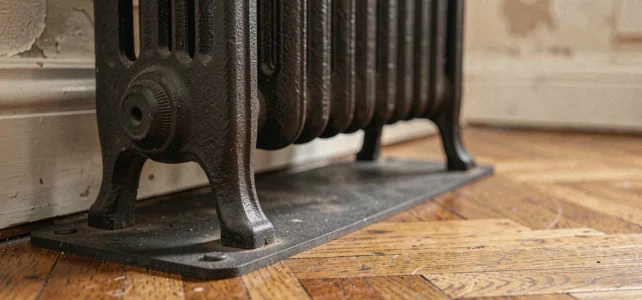
A cast iron radiator is heavy, heats by radiation, and concentrates its thermal effects on a small area of the floor. The parquet located just below therefore undergoes a double constraint: mechanical pressure from the feet and localized drying of the wood. Protecting this area is not merely a decorative gesture, but a set of technical precautions related to installation, support, and humidity management.
Fixed point and compressible underlay: the trap of floating parquet under cast iron radiators
The majority of floating parquet floors rest on a compressible underlay that allows the floor to expand freely. This mechanism works as long as nothing blocks the movement of the planks.
A cast iron radiator placed directly on a floating parquet creates a fixed point. The foot sinks into the underlay, compresses the material, and cancels the floating effect in that specific area. Neighboring planks continue to move with humidity variations, but those located under the radiator remain stuck. This offset causes internal tensions: joints that open, planks that lift, creaking.
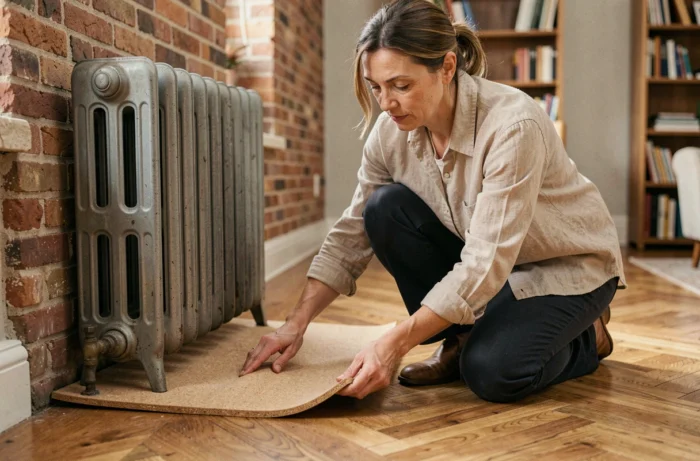
The current recommendation is to insert a rigid plate under the foot of the radiator. Marine plywood or a steel plate distributes the load over a larger surface and limits sinking into the underlay. This plate should ideally be placed under the covering, not just between the foot and the visible plank, so you can learn more on the ID Habitat website about feet suitable for fragile parquet floors.
Expansion gaps and localized heat: what the parquet DTUs impose
The installation standards for parquet have evolved recently and directly regulate situations where the floor is subjected to a heat source. The standard NF DTU 51.11 (floating parquet), published in May 2024, specifies the requirements for flatness, expansion gaps, and humidity management.
The NF DTU 51.1 (nailed parquet, amended in April 2023) and NF DTU 51.2 (glued parquet, revised in March 2023) also emphasize the control of humidity and peripheral gaps. Under a cast iron radiator, the heat is localized and can cause deformations if the parquet is installed in contact without a gap.
Specifically, the wood located in the radiation zone loses its moisture faster than the rest of the room. The planks shrink, the joints widen, and if the peripheral gap provided during installation is insufficient, the planks can crack on the surface. The DTU requires an expansion gap around the perimeter of the room, but the area under the radiator requires the same treatment as a wall: a free space around the feet and under the appliance.
Adapting the type of installation to thermal constraints
A glued parquet on a rigid support withstands this situation better than a floating parquet. The glue keeps the planks in place despite dimensional variations, and the absence of a compressible underlay eliminates the sinking problem. Field reports vary on this point, but installers specializing in the renovation of old buildings often prefer gluing in areas exposed to the heat of cast iron radiators.
Wood moisture and localized drying: monitor rather than react
Wood parquet is a hygroscopic material. It absorbs and releases moisture depending on the ambient air. A cast iron radiator, through its direct radiation, creates a microclimate at the floor level: the surface temperature can significantly exceed that of the rest of the room, accelerating the evaporation of water contained in the wood.
This phenomenon is not immediately visible. The first signs appear after one or two heating seasons: slight shrinkage of the planks, appearance of micro-cracks along the grain, uneven patina of the finish. The wood does not swell under a cast iron radiator; it dries.
- Maintaining a relative humidity level between 45 and 65% in the room limits localized drying. An air humidifier placed near the radiator partially compensates for the drying effect.
- Applying an oil or varnish suitable for heated parquet enhances the surface moisture barrier. An oiled finish is easier to renew than a varnish in a restricted access area under a radiator.
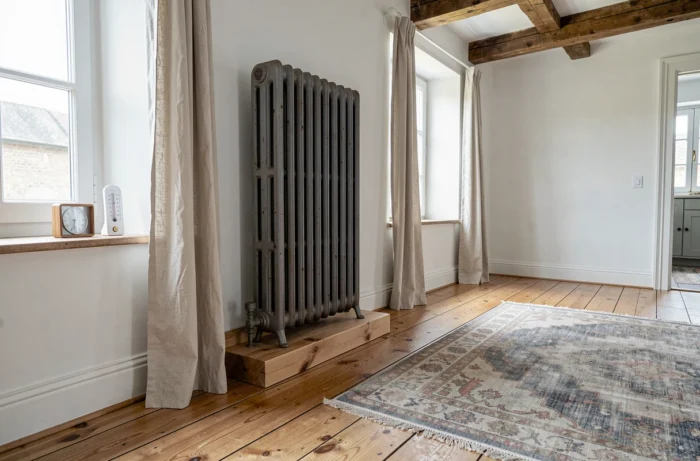
- Avoid placing a thick rug under the radiator: it traps heat and amplifies the drying of the wood underneath.
Protecting parquet from cast iron radiator foot marks
The feet of a cast iron radiator concentrate the weight of the appliance on a few square centimeters. On a soft parquet (pine, fir, some unseasoned oaks), impressions appear within a few weeks.
Load distribution solutions
The rigid plate mentioned above also mechanically protects the surface. Here are a few concrete options:
- A metal cup under each foot, wide enough to distribute the pressure. The diameter of the cup should be at least three times greater than that of the foot.
- A marine plywood base cut to the dimensions of the radiator, placed under all the feet. Marine plywood resists the residual moisture from the floor and does not deform under heat.
- A technical felt between the plate and the parquet absorbs micro-vibrations related to the flow of water in the heating circuit while protecting the wood finish.
- Teflon or high-temperature silicone pads glued under the feet, suitable for varnished parquet but less durable on oiled parquet where they may leave greasy marks.
Regularly check the condition of the wood under the radiator
Access under a cast iron radiator is often limited. A visual inspection once a year, ideally at the end of the heating season, allows you to spot the first signs of wear before they become irreversible. If the planks show visible shrinkage, locally re-oiling the affected area before the next heating season slows down degradation.
Protecting fragile parquet under a cast iron radiator relies on three axes that work together: distributing mechanical load, respecting the expansion gaps required by the DTUs, and maintaining a stable humidity level in the room. Neglecting any one of these three points is enough to degrade the wood within two or three winters.