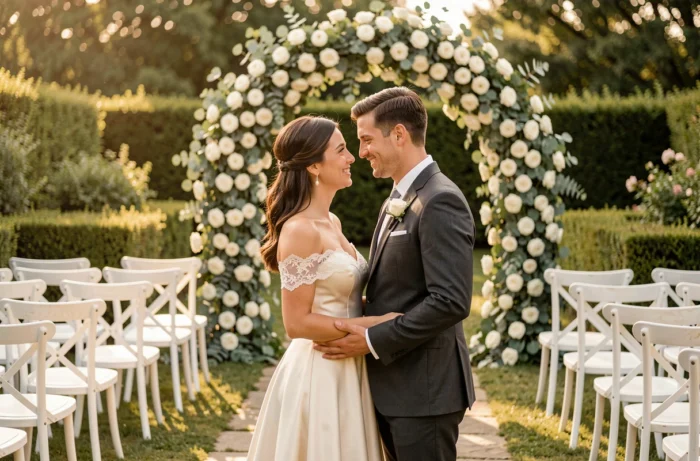
What budget items separate a wedding perceived as elegant from a classic reception? The answer lies less in the total amount than in the distribution of expenses. Venue, floral decoration, photography, catering: the way a couple balances these categories determines the level of refinement felt by the guests, often more than the total budget itself.
Budget distribution of an elegant wedding compared to a standard wedding
Most couples start by setting a global envelope, then allocate the items by reflex. An elegance-oriented wedding does the opposite: it identifies two or three priority items and adjusts the rest accordingly.
| Expense Item | Standard Wedding (budget share) | Elegant Wedding (budget share) |
|---|---|---|
| Reception Venue | About 30% | About 35-40% |
| Caterer / Catering | About 25-30% | About 20-25% |
| Floral Decoration and Scenography | About 5-8% | About 12-15% |
| Photography / Video | About 8-10% | About 10-12% |
| Entertainment / DJ / Orchestra | About 8-10% | Variable |
The most striking difference concerns decoration and scenography. An elegant wedding nearly doubles the share allocated to the visual ambiance, which includes lighting, table setting, and floral work. In contrast, the share dedicated to catering decreases proportionally, not because the quality declines, but because reducing the number of guests allows for higher quality per plate.
The choice of venue also absorbs a larger share. A property with strong architecture or a well-designed landscape reduces the need for added decoration. This is a trade-off that couples often underestimate: a self-sufficient venue compensates for thousands of euros in scenography.
Micro-wedding and celebration stay: two formats redefining elegance
Recent analyses confirm that weddings with fewer than 50 guests are no longer a budget compromise. Generation Z couples make it a conscious choice for high-end: fewer guests, more investment per person in decor, gastronomy, and overall experience. The micro-wedding is establishing itself as a mainstream option in the luxury segment, driven by values of intimacy and reduced environmental impact.
At the same time, more and more couples are transforming their wedding into a two to three-day celebration. The classic structure consists of a welcome dinner on Friday, the ceremony and reception on Saturday, followed by a brunch or friendly activity on Sunday. This format allows for a much denser collective memory than a single day and fits naturally into an elegant wedding with a small guest list.
Specialized platforms like Mariages Chics focus on providers and venues suited to these intimate formats, where every detail matters more than on a larger scale.
The link between these two trends is direct. A celebration stay with 30 guests allows for a different budget allocation: on-site accommodation, exceptional multi-course meals, and decoration designed for a single cohesive space. In contrast, a wedding with 150 people over an entire weekend multiplies logistical costs without necessarily gaining perceived quality.
Wedding decoration and visual coherence: high-impact items
The elegance of a wedding lies in coherence, not accumulation. Three levers produce a disproportionate effect relative to their cost:
- Ambient lighting: warm filament string lights, numerous candles, indirect lighting on floral arrangements. This item, often overlooked, transforms any venue after 9 PM.
- Coordinated stationery: from the invitation to the table menu to the seating plan, a unique graphic line enhances the impression of refinement. Guests may not always consciously identify it, but the cumulative effect is measurable in feedback.
- Mass floral work rather than variety: one abundant flower variety has more impact than an assortment of five species. This choice also simplifies logistics with the florist and reduces the risk of uneven results between tables.
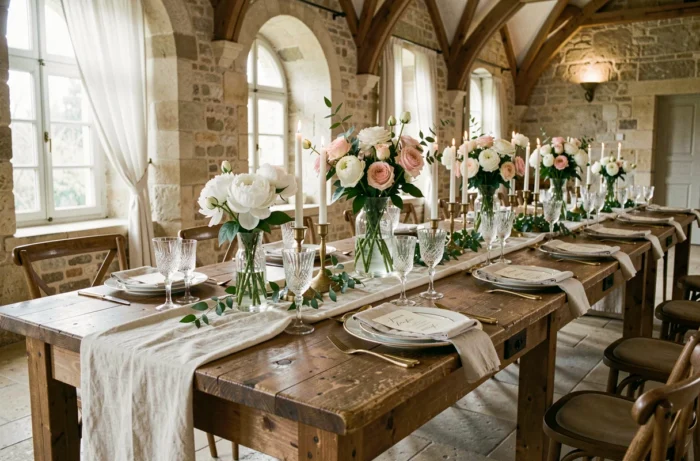
The reception table remains the focal point of an elegant wedding. The choice between round tables and a large rectangular table alters the evening’s dynamics. The single long table, borrowed from Italian and Provençal weddings, creates immediate conviviality and lends itself better to a linear scenography with low arrangements.
Wedding photography: what the choice of provider reveals
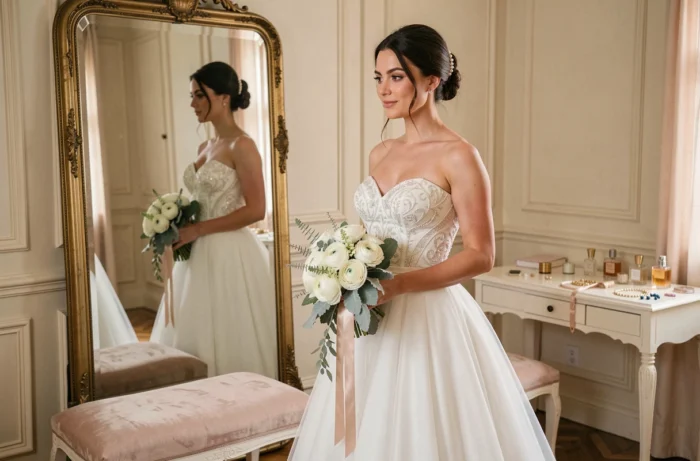
The photographer is the only vendor whose work survives the day. It is also the one whose style retroactively influences the perception of the wedding: a natural light reportage with few poses will yield a radically different result from a photographer focused on classic portraits.
For an elegant wedding, two selection criteria deserve more attention than the hourly rate:
- The consistency of treatment between series: a good wedding photographer maintains the same color rendering from preparations to the ball. Portfolios showing warm tones in preparation and cool tones in the evening indicate inconsistent post-processing.
- The ability to document without directing: the candid shots taken during the ceremony and dinner are the ones couples prefer, more than posed couple series. A photographer who requests too many staged moments during the cocktail slows down the reception’s pace.
- Experience with the type of venue chosen: a photographer accustomed to outdoor properties does not manage the lighting of a castle in the same way. Requesting a complete reportage done under similar conditions remains the best filter.
Investment in photography and videography represents the expense whose return is measured over years. A couple satisfied with their photos positively reevaluates their entire wedding, even if other items were not perfect on the day.
The final trade-off concerns the style of the ceremony itself. A well-written secular ceremony, with personal texts and a symbolic ritual chosen by the couple, produces more striking images and memories than a lavish organization without a structured emotional moment. The elegance of a wedding is not measured after dessert, but in the accuracy of the choices made beforehand.