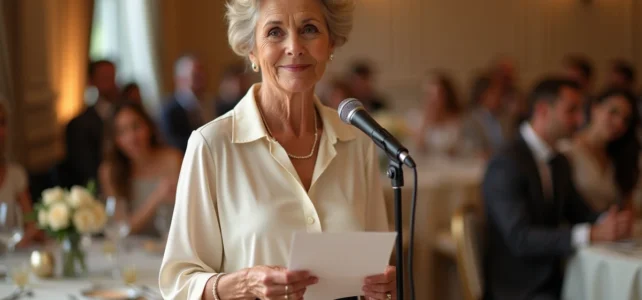
During the rehearsal dinner or the wedding evening, the mother of the groom who takes the microphone faces a very concrete difficulty: speaking in front of an audience that expects emotion, without slipping into an endless monologue or repeating what the father or witnesses have already said.
The context has changed in recent years, with couples sometimes explicitly requesting a short duration and a controlled tone to maintain the rhythm of the evening.
Setting the duration and format before writing a word
One often starts by looking for content ideas. The first thing to settle is the format. Many couples now structure the flow of speeches to avoid moments that are too long, awkward, or repetitive. Before writing anything, we ask the newlyweds how much time they wish to allocate to each speech and in what order they will follow.
A speech from the mother of the groom to her son benefits from being concise. A few minutes are enough to make an impression, provided that each sentence carries a specific memory or a clear intention. Exceeding this threshold risks losing the guests’ attention and diluting the emotion.
Another trend that is becoming more common: the pre-recorded video speech. Some mothers choose to record their message in advance, projected during the evening. This option addresses the issue of stage fright, allows for retakes as needed, and proves valuable in cases of geographical distance or fragile health. Wedding videographers report that preparation is often more polished in this format because one can adjust the pace and tone without the pressure of live performance.
Finding the right anecdote for a sincere wedding speech
The classic pitfall is wanting to recount an entire life in three minutes. One accumulates childhood memories, the first day of school, the first bike, the meeting with the daughter-in-law, and the speech becomes a chronological catalog. The result sounds false, even if every detail is true.
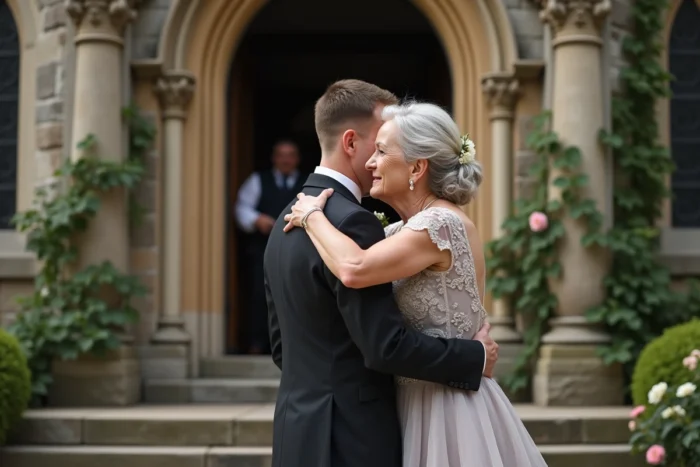
One well-chosen anecdote is worth more than five skimmed over. We look for the moment that says something profound about the son’s character, not the most spectacular memory. A detail from everyday life (his way of comforting a friend, a phrase he repeated as a child, a gesture that can still be seen today) creates a thread between the little boy and the man who is getting married.
What works in choosing a memory
- A moment where the son showed a quality that his partner will immediately recognize, which includes the couple in the narrative instead of excluding them.
- A short scene, situable in time and space (a place, a season, a specific age), so that the guests can visualize the scene instead of listening to an abstract summary.
- A memory that does not make the son uncomfortable. We check before the big day: some funny anecdotes for the family can be humiliating in front of colleagues or in-laws.
Feedback varies on this point, but many mothers find afterward that the funny anecdote that “always worked” in the family falls flat in front of a mixed audience. It’s better to test the son’s reaction in advance.
Integrating the couple without erasing the mother-son relationship
A speech that only talks about the son, without a word about the person he is marrying, gives the impression of ignoring the reality of the day. Conversely, a speech entirely focused on the couple loses what makes it unique: a mother’s words to her child who has become an adult.
The balance lies in the transition. One starts with the son (the anecdote, the character trait), then shows how his partner extends or complements that trait. No need for solemn formulas about love or happiness. A concrete observation is enough: since they have been together, we have seen such a change, such a new habit, such a common project.
Words to address the daughter-in-law or son-in-law
Welcoming without taking possession. One does not “gain a daughter,” one simply acknowledges that this person matters. Naming what one appreciates about her (a gesture, an exchange, a shared moment) carries more weight than a generic welcome statement into the family.
Addressing a few sentences directly to the daughter-in-law or son-in-law in front of the guests creates a moment of complicity that the room perceives. It is also a way to show that the speech is not a nostalgic monologue looking back.
Managing stage fright and voice on the wedding day
One can have written a perfect text and make it inaudible on the big day. Stage fright is managed through physical preparation, not just mental. Reading one’s speech aloud, standing, at least three times before the wedding gives a realistic idea of the pace and the passages where the voice may crack.
- Print the text in large letters on a stiff sheet or cardboard, not on a phone whose screen locks or whose brightness is distracting.
- Mark pauses directly in the text (a line, a line break) to force oneself to breathe at the right places.
- Have a glass of water within reach. When emotions rise, a sip of water provides a few seconds to compose oneself without the room noticing a pause.
- Accept tears. Crying while reading a passage does not ruin a speech. What ruins it is apologizing five times for being emotional. One cries, regains composure, and continues.
If despite everything the idea of speaking in front of the audience remains paralyzing, the pre-recorded video format mentioned above remains a concrete alternative. Nothing requires choosing the live microphone for the message to be sincere and memorable.
A mother’s speech to her son on his wedding day does not need to be long, literary, or perfectly structured. A specific memory, a few words for the couple, a voice that embraces its emotions: this is what the guests remember, and above all, what the son will keep.