A fashion trend, in the strict sense, refers to an aesthetic direction adopted by several houses during the runway shows of the same season, which is then relayed into ready-to-wear. For the autumn-winter 2026 season, the collections presented at Fashion Weeks outline clear lines: saturated colors, generous volumes, intricate textures, and, more recently, pieces from circular supply chains that change the very way of composing a look.
Structured upcycling: the fashion trend that changes the production of pieces
Seasonal guides list colors and cuts without addressing the origin of the garments. This season, the rise of measured upcycling deserves a rightful place in the wardrobe.
The Parisian laboratory Collectivo, specializing in upcycled ready-to-wear, announces an average reduction of 92% in carbon footprint per piece compared to an equivalent new production. The process relies on the recovery of discarded denim, leather, and knitwear. Each garment comes with a traceability label indicating the carbon impact and the volumes of transformed textiles.
For those who want to explore the fashion section of BestWeb, this type of piece opens a precise stylistic register: reconstructed tailored trousers, sculpted bomber jackets, asymmetrical bubble dresses. The result is radically different from the recycled basics one might spontaneously think of. We are talking about a reconstructed tailored wardrobe that is as much about office wear as it is about textile art pieces.

Bright colors and autumn palette: how to choose without overloading your style
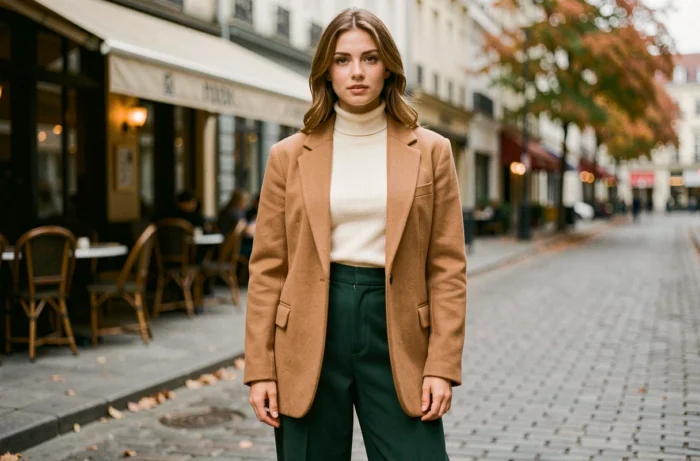
The autumn-winter 2026 shows confirm the massive presence of saturated shades, sometimes grouped under the label “over the rainbow.” Specifically, this means that cherry red, cobalt blue, and emerald green are worn as a solid color on a single strong piece, rather than in a multicolored total look.
The principle is simple: one bright color per outfit is enough to structure a look. The rest of the silhouette remains understated (black, gray, off-white, beige). This rule avoids the costume effect created by combinations of three or more bold shades in the same ensemble.
Pairing materials with colors
Color changes in intensity depending on the material that carries it. A boiled wool red appears duller than a satin red. For this season, textured materials (corduroy, thick knit, tweed) absorb light and soften bright shades. Conversely, shiny fabrics amplify saturation.
Choosing a matte material for a very bright color, or a shiny material for a discreet color, allows for precise visual impact control. It is a more refined stylistic lever than simply choosing color.
Oversized volumes and fitted cuts: the contrast that defines the silhouette
The gender-neutral wardrobe, often summarized by the term “working girl” in runway reports, is based this season on a principle of contrast between a loose volume on top and a more fitted cut below, or vice versa.
This play of proportions works well with a few precise combinations:
- Oversized blazer paired with straight jeans or cigarette pants, to maintain a clean leg line under a marked shoulder volume.
- Loose drop-stitch sweater tucked into a pencil skirt or high-waisted trousers, creating a visible waist point despite the bulk of the knit.
- Long straight coat worn open over a fitted dress, allowing the silhouette to breathe without drowning proportions.
A common mistake is to multiply loose volumes on both the top and bottom simultaneously. The result obscures the silhouette instead of enhancing it. One loose volume per outfit remains the most reliable rule.
Circular fashion and resale: a trend that changes seasonal shopping habits
Circular fashion has now surpassed the niche market stage. LVMH has begun a shift towards models that integrate circularity from the design stage, a structural change that goes beyond the slogan “buy less but better.” Specifically, some luxury pieces are designed to be disassembled, repaired, or resold without loss of quality.
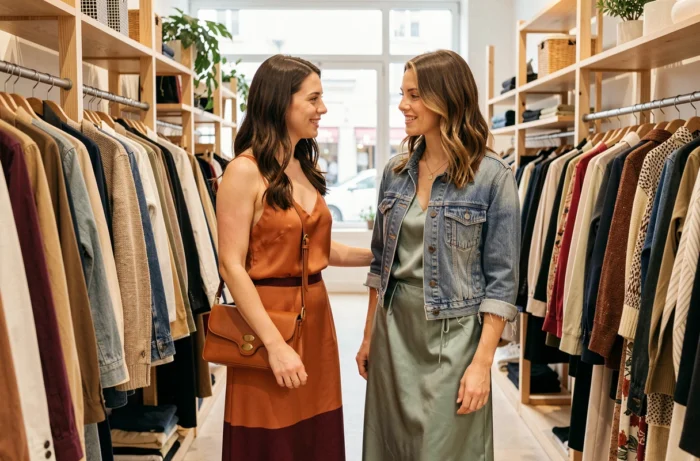
For a unique style this season, this evolution has a direct consequence: high-end second-hand pieces become integral wardrobe elements. A designer jacket bought second-hand can be the standout piece of an outfit, around which more accessible new basics revolve.
Building a mixed look with new and second-hand
The logic is that of a pyramidal wardrobe. At the base, simple and durable pieces bought new (raw jeans, thick cotton t-shirt, leather ankle boots). At the top, one or two pieces with strong visual identity, often more expensive, acquired from the resale market.
This approach modifies the relationship to the fashion budget. Instead of spreading the same amount over many average pieces, one concentrates the investment on a smaller number of garments with high stylistic impact. The result is a more readable, personal look, less dependent on the micro-trends that succeed each month on social media.
The autumn-winter 2026 trends outline a wardrobe where the origin of a piece matters as much as its cut or color. Between traceable upcycling, carefully dosed bright color palette, and controlled volume play, the season rewards precise choices rather than accumulation. The most current piece in your wardrobe may well be one that has already lived a first life.