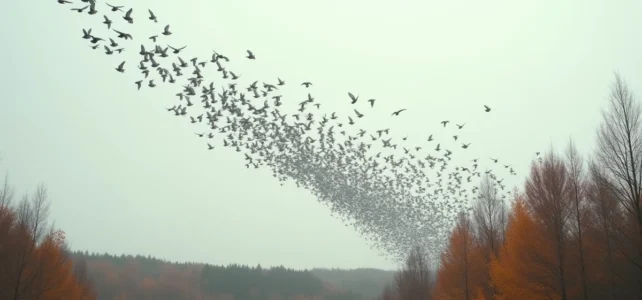
The 2024 season was marked by late flights, slow days in the heart of October, and a peak concentrated over a few days at the end of October that disrupted habits in the South-West. For 2025, the available signals outline a scenario that is both familiar and offbeat, where autumn weather and the progression of sedentary populations redistribute the cards.
Sedentary and migratory wood pigeons: a mix that skews the counts
The first concrete problem when trying to assess the quality of a migration season relates to the population of sedentary wood pigeons, which has been increasing in France for several years. These birds stay in place all year round, nesting in urban parks, agricultural groves, and mingling with autumn flights.
The result on the ground is simple: autumn counts mix passing birds and residents, which muddles the indicators used by hunters to gauge migration. A flight of several hundred wood pigeons observed in Gironde in mid-October may very well include a significant portion of local birds that are merely moving between feeding areas.
For those following the trends of wood pigeon migration on Max Trucs, this confusion between sedentary and migratory birds complicates any reliable forecasting. One can no longer rely solely on the raw volume of observations to anticipate the passages.

Autumn weather 2025: why the passage is likely to be spread out
The seasonal climate trends published by Météo-France for the upcoming autumn indicate a warmer-than-normal scenario across the entire territory, with increased probabilities in the East and the alpine area. This type of configuration has direct consequences on the migratory behavior of wood pigeons.
Fewer early cold snaps, fewer grouped departures
Wood pigeons trigger their migration primarily under the influence of two factors: photoperiod (shortening of days) and weather conditions, particularly northeast winds and temperature drops. A mild autumn delays the departure signal for some birds stationed in Northern Europe.
A warmer-than-normal autumn favors a spread-out passage rather than a well-defined “big event.” Instead of one or two massive waves, diffuse movements are observed over several weeks, with modest days interspersed with rare peaks.
What recent counts at the Pyrenean passes indicate
Data from the Pyrenean passes for the previous season show that nearly 40% of the migratory flow occurred during the last decade of October, with spectacular days like October 26, 2025, when over 190,000 wood pigeons were counted in a single day. This pattern of late concentration could repeat in 2025 if mild conditions persist in the first half of October.
To anticipate the timing, the elements to monitor remain the same:
- The daily counts at Falsterbo, Sweden, which signal the departure of Scandinavian birds (a peak at Falsterbo indicates an arrival in France within 7 to 9 days with favorable weather)
- The establishment of a northeast flow over Western Europe, a classic trigger for large waves
- The three-month Météo-France bulletins, which help calibrate expectations regarding the grouped or diffuse nature of the passage
Wood pigeon migration forecasts for October-November 2025: the likely scenario
By crossing weather trends and observations from recent seasons, the most plausible scenario for 2025 is structured around three phases.
Early October: timid movements, limited to the most northern birds already on the move. These first flights often go unnoticed outside fixed observation posts. If northeast winds set in early, an early wave remains possible, but this is the minority scenario.
The period from October 20 to 31 statistically concentrates the bulk of the passage. This is when the wood pigeon hides in the South-West have the best chances of seeing significant flights. One or two days of very high passage (like October 26, 2025) are likely if a favorable wind episode coincides with the window.
In November, the latecomers pass in reduced flow. Birds that have not yet migrated by the end of October do so in small groups, often at high altitude, making them less accessible from traditional hides.

Adapting your wood pigeon hunting post to these developments
On the ground, a spread-out passage changes the game for organizing the season. Where one could once rely on an intense week around Saint-Luc (October 18), one must now accept covering a broader range.
Feedback varies on this point depending on the sectors, but several observations recur:
- Decoys must be in place from early October to catch the first flights, even modest ones
- Regular presence at the post throughout the October-November period compensates for the absence of a single peak
- Local sedentary wood pigeons react to decoys, which can create the illusion of a good passage while the migratory birds are not yet there
Differentiating between sedentary and migratory birds from the post is not straightforward. Migratory birds generally fly higher, in more elongated formations, and follow a more linear northeast/southwest trajectory. Sedentary birds turn, easily descend, and frequent the same feeding areas day after day.
With a likely mild autumn, hunters who achieve the best results will be those capable of staying mobilized over the long term rather than betting everything on a single peak. Data from the Pyrenean passes and Falsterbo remain the best tools for adjusting one’s schedule in real time, week after week.