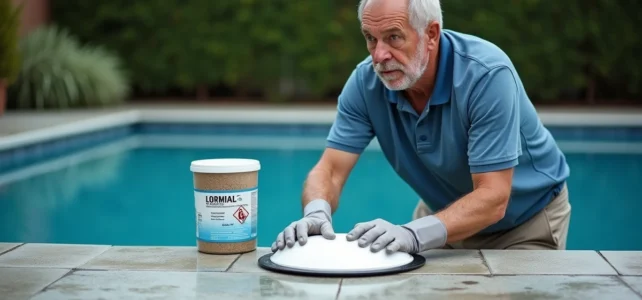
Shock chlorine is a common reflex when the pool water turns green or becomes cloudy after a storm. The action seems logical: open the skimmer lid, pour in the powder or granules, and let the filtration do the rest. However, this habit exposes the hydraulic circuit, swimmers, and equipment to damage that most pool owners do not suspect.
Chemical reaction in the skimmer basket: what really happens
The skimmer is a confined space, with a very small volume of water compared to the pool. When shock chlorine (often calcium hypochlorite) dissolves in this small volume, the local concentration rises to levels unrelated to the target level for the pool.
Have you ever noticed a sharp smell near the technical room after a shock treatment? That’s gaseous chlorine being released, precisely because the dissolution occurs in a space that is too narrow. This reaction intensifies when the pump stops: the product continues to release into stagnant water, and the concentration becomes corrosive.
The problem worsens if another product is already in the skimmer. Mixing shock chlorine with an acidic pH corrector causes an exothermic reaction accompanied by corrosive splashes and toxic gas. The same danger exists if stabilized organic chlorine tablets are still in the basket: direct contact between these two forms of chlorine can generate a violent reaction.
To better understand the risks of shock chlorine in the skimmer, one must consider both the chemical and mechanical aspects.
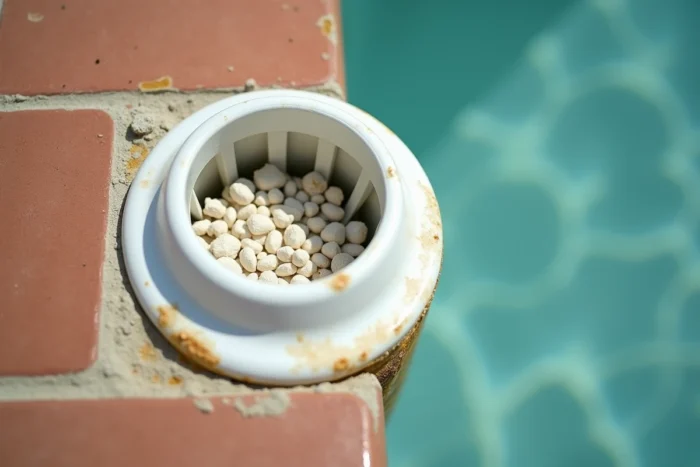
Damage to the hydraulic circuit and filtration
The local overdose of chlorine does not remain confined to the basket. It circulates through the pipes between the skimmer and the filter, then passes through the pump. Each component endures a concentration much higher than it was designed for.
Seals, pipes, and basket: the first affected
The plastic of the skimmer basket weakens due to repeated exposure. It becomes brittle, cracks, and eventually breaks. The O-rings of the pump and filter suffer the same fate: concentrated chlorine dries out and cracks the elastomers.
The PVC pipes connecting the skimmer to the technical room are exposed with each treatment. Over time, micro-cracks appear. These leaks are insidious: they manifest as a drop in water level or a loss of pressure, without any visible signs on the surface.
Pump and filter: accelerated aging
The pump turbine and filter body seals are not designed to withstand spikes in chlorine concentration. The phenomenon is cumulative. After several seasons of shock treatment poured into the skimmer, the lifespan of the equipment is significantly reduced. Repairs (replacement of pump, valves, buried pipes) represent a cost much higher than that of a simple floating doser.
- The skimmer basket deforms and breaks, allowing debris to pass into the pump.
- The O-rings lose their tightness, causing leaks in the technical room.
- The PVC pipes develop micro-cracks that are difficult to detect without an inspection camera.
- The pump turbine wears out prematurely due to repeated chemical corrosion.
Chlorine vapors in the technical room: an underestimated health risk
Pool technical rooms are often closed or semi-closed spaces, sometimes integrated into a garage or garden shed. When shock chlorine dissolves in the skimmer, chlorine vapors rise through the pipes to the technical room.
In a poorly ventilated space, these vapors irritate the respiratory tract and mucous membranes. Repeated exposure, even at low doses, can lead to chronic respiratory issues. The risk increases if the room stores other chemical products (pH minus, algaecide, flocculant), as the vapors can interact with each other.
A technical room must always be ventilated when a treatment is underway. Pouring shock chlorine directly into the pool, rather than into the skimmer, significantly reduces the concentration of vapors in this enclosed space.
Manufacturer’s warranty and shock chlorine in the skimmer
This point often goes unnoticed. Several manufacturers of pools and filtration equipment mention in their warranty conditions that the introduction of concentrated chemicals into the skimmer voids the coverage. The logic is simple: the manufacturer sizes its parts for water treated at the normal pool concentration, not for a bath of pure chlorine.
In the event of a leak in a pipe or pump breakage, the pool technician may refuse coverage if they find signs of chemical corrosion in the skimmer circuit. Checking the warranty conditions of your equipment before any chemical handling avoids unpleasant surprises.
Using shock chlorine safely: alternatives to the skimmer
The correct method is to dissolve shock chlorine in a bucket of warm water, then distribute the mixture directly into the pool while the filtration is running. This prior dilution avoids local overdosing and protects the hydraulic circuit.
- Dilute shock chlorine in a bucket of water before pouring it into the pool, never in contact with the walls or bottom.
- Never mix two treatment products in the same container or pour them successively into the skimmer.
- Use a floating doser only for slow-release chlorine tablets, never for shock chlorine.
- Run the filtration continuously for several hours after treatment to homogenize the concentration.
Shock chlorine has no place in the skimmer, regardless of the situation. This simple rule preserves the equipment, protects the health of users, and maintains the manufacturer’s warranty. If your pool water requires emergency treatment, a few minutes of preparation in a bucket is enough to avoid damages that can amount to hundreds of euros in repairs.