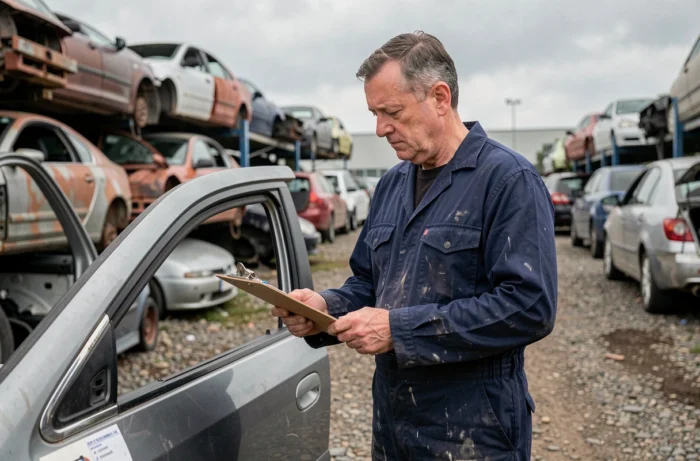
An auto salvage yard, or end-of-life vehicle treatment centre, is an authorised facility that takes in end-of-life vehicles, removes reusable parts and arranges for the rest to be destroyed. In Nord-Pas-de-Calais, the high concentration of these professionals makes choosing one less straightforward than it might seem. Here are seven practical criteria to help you distinguish a reliable operator from a questionable middleman.
1. Check the centre’s ELV authorisation
The prefectural ELV authorisation is the first thing to check. The French Environmental Code requires that only authorised centres handle the destruction of an end-of-life vehicle. Selling spare parts or providing breakdown services does not prove that a business is qualified to process your scrap vehicle.
Every authorised centre has an authorisation number issued by the prefecture. Before handing over your vehicle, ask for this number and check that it appears in the official directory of ELV centres. Be wary of any professional who refuses to provide this information or refers you to a third party for the destruction.
When choosing an auto salvage professional with Nox Autos, this check is the foundation of any serious approach in the region.
2. Check the transfer certificate and proof of destruction
When handing a vehicle over to an authorised centre, two documents are involved: the transfer certificate (which transfers ownership) and the certificate of destruction (which confirms that the vehicle has been permanently taken off the road). Without the latter, you remain legally responsible for the vehicle.
The centre must submit the information required for the administrative destruction process. Compare professionals on how quickly and reliably they provide these documents, not just on the cost of collection.
A reputable professional will give you the destruction receipt on the same day or within a few days. If the stated timeframe is more than a week with no clear explanation, look elsewhere.
3. Check part compatibility before buying
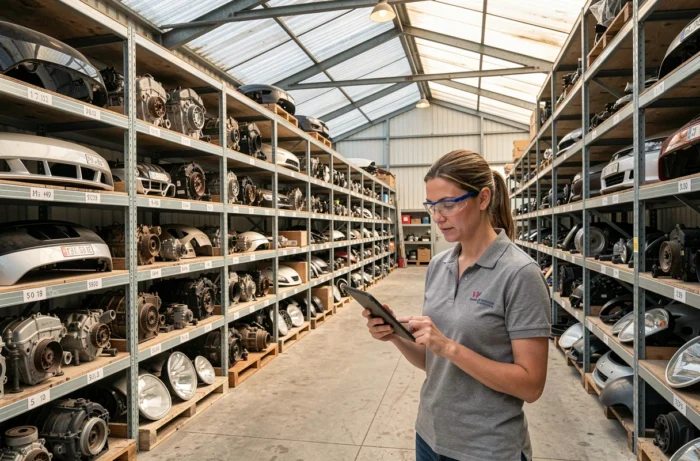
Buying a used part from an auto salvage yard in Nord-Pas-de-Calais means making sure it matches your vehicle exactly. An identical manufacturer part number does not always guarantee compatibility: engine, model year or trim variations can affect the mounting points or connectors.
A good professional checks part-to-vehicle compatibility using your registration number or vehicle registration document. They identify the exact part number and let you know about any differences between versions. Centres that simply say “it should fit” without checking properly risk leaving customers with a costly return.
- Always provide your registration number or the OPR code for the part you need
- Ask whether the part comes from a vehicle with the same model year and engine
- Check the return policy in case the part is confirmed to be incompatible
4. Compare the fees charged by auto salvage yards
Collection of an end-of-life vehicle is generally free when carried out by an authorised ELV centre. However, some professionals charge additional fees for travel outside their service area, collecting a non-running vehicle from a hard-to-reach location, or missing parts (battery, catalytic converter).
Prices for used spare parts can vary significantly between two auto salvage yards in the region, even for the same component. Compare at least three quotes before making a purchase to spot unusually low prices (the part may not have been tested) or excessive ones (an unreasonable markup).
Remember to factor in delivery costs if you cannot collect the part yourself. Some centres in northern France offer shipping, while others only allow collection in person.
5. Read customer reviews before visiting
Online reviews are no substitute for a visit, but they can reveal patterns. A centre with dozens of reviews and a consistently good rating offers more reassurance than a business with no visible feedback.
Focus on three specific points as you read:
- Whether the parts supplied match the order
- Whether collection or delivery deadlines are met
- The quality of after-sales service if something goes wrong (returns, exchanges, refunds)
One-off negative reviews matter less than recurring complaints. If several customers report incompatible parts or documents that never arrived, the warning signs are clear.
6. Check the centre’s opening hours and location
An auto salvage yard in Nord-Pas-de-Calais may be located in an industrial area and have limited opening hours, from Monday to Friday. If you work during the day, check whether the centre offers Saturday morning or late-day appointments.
Location also affects costs. A centre in Béthune will charge a different amount to collect a vehicle in Dunkirk than a centre in Lille would. Look for professionals whose service area covers your town without an extra charge.
Some centres list the areas covered by their free collection service directly on their website. Others ask you to call to confirm. It is best to clarify this before booking an appointment.
7. Ask for an itemised quote for each service
An itemised quote sets a well-organised professional apart from a questionable operator. For a part purchase, the document should state the exact part number, its condition, the length of the commercial warranty and the return policy.
For vehicle collection, the quote should specify whether the service is free, whether any fees apply and under what conditions. It should also state when you will receive the certificate of destruction.
As for warranties on used parts, the statutory guarantee of conformity applies when the seller is a professional. For a used item, any defects found are presumed to have existed before the sale for twelve months. Some salvage yards also offer a longer commercial warranty, sometimes up to twenty-four months. Check exactly what the warranty covers before making price your only deciding factor.
Nord-Pas-de-Calais has enough authorised ELV centres to make a meaningful comparison. A professional who provides verifiable authorisation, documents on time, a clear quote and parts compatible with your vehicle meets the essential requirements. Everything else is about convenience, not safety.