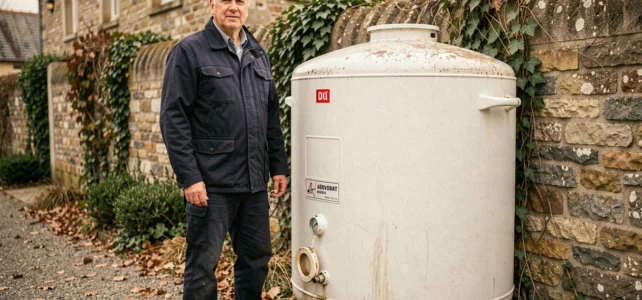
When you receive the heating oil bill in the middle of winter, the instinct is to check if you’ve paid the right price. The problem is that two households located just a few dozen kilometers apart can see a difference of several hundred euros for the same quantity. The price of 1000 liters of domestic heating oil in France depends on a cost chain that online comparators do not always detail.
Price differences between municipalities: what happens between the depot and the tank
It is often thought that the price of oil solely dictates the bill. In practice, the distance between the distributor’s depot and the customer’s tank weighs as much as the crude oil quotation on the final price. A household in a remote rural area will pay a transport surcharge that its neighbor in the urban outskirts will never see.
Several factors make up the price per liter:
- The cost of the raw material (crude oil) and refining, which are identical from one supplier to another in the same market.
- The taxes, including the TICPE, which represent a fixed part independent of the distributor.
- The distributor’s margin and logistics cost (transport from the refinery, then delivery to the tank), which vary greatly depending on the region and the volume ordered.
It is on this last point that the differences between suppliers really widen. Two distributors in the same department can display different prices simply because one has a depot closer to your municipality. Consulting a comparison of domestic heating oil prices allows you to visualize these differences before placing an order.
Ordered volume and grouping: a lever that many underestimate
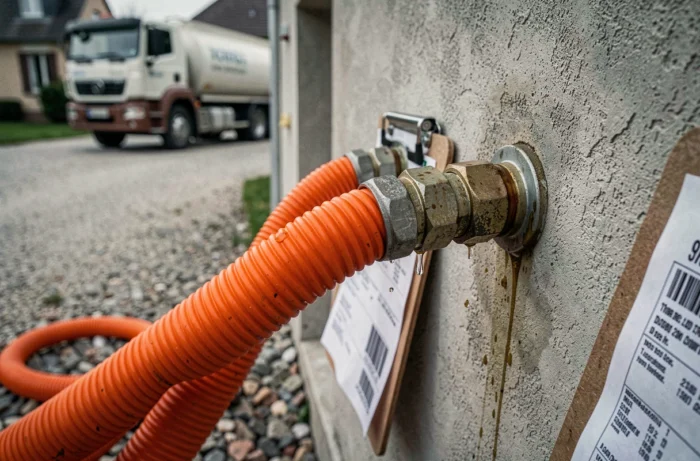
Ordering 500 liters is proportionally more expensive than ordering 1000 liters. The tanker truck travels for a small volume, and the delivery cost remains almost the same. Moving from 500 to 1000 liters significantly lowers the price per liter.
Grouped ordering takes this logic further. Several households in the same area place an order together: the distributor optimizes its route and passes on part of the savings. On specialized platforms, group rates regularly show a lower price than individual orders for an equivalent volume.
When to order to pay less
Heating oil follows a marked seasonality. Demand rises in autumn when households anticipate winter, which tends to push prices up. Ordering at the end of spring or in summer, when demand weakens, remains the simplest strategy to reduce the bill. Feedback varies on this point from year to year, but the seasonal trend is confirmed in most recent periods.
Ordinary oil or superior oil: an extra cost that is not always justified
Comparators display two lines: ordinary oil and superior oil (or “first”). The price difference per liter exists but remains modest compared to 1000 liters. Superior oil contains additives intended to improve combustion, reduce boiler fouling, and limit odors.
The real gain depends on the age and condition of the boiler. On a recent and well-maintained unit, the performance gap is marginal. On an older installation, additives can slow down burner fouling and extend maintenance intervals. Before paying the extra cost, check the condition of your boiler with the technician during the annual maintenance.

Ban on new oil boilers: what it changes for the price
Since July 1, 2022, the installation of new heating equipment exceeding 300 g CO₂eq/kWh PCI is prohibited. This threshold, set by decree n° 2022-8 of January 5, 2022, effectively excludes boilers that operate exclusively on oil.
Existing boilers can be kept, maintained, and repaired without an explicit deadline. However, a like-for-like replacement with a new unit is no longer allowed if it exceeds the emissions threshold. In practical terms, a household whose boiler breaks down will have to turn to a heat pump, a pellet boiler, or a hybrid system.
What impact on the domestic heating oil market
The customer base is mechanically shrinking each year. Sector analyses converge towards a gradual exit from residential oil heating between 2028 and 2030. Fewer customers mean less dense delivery routes, which could keep logistics costs high per liter, even if the price of oil drops.
For households still equipped, the calculation deserves to be made: continue to buy oil at the current rate and bear the risk of a tax increase, or invest in a system change while taking advantage of energy renovation aids (notably MaPrimeRénov’).
Follow the evolution of heating oil prices in France
The price of domestic heating oil follows that of crude oil, but with a delay of a few days due to refining and logistics. National averages published by comparators or by data from the Ministry of Ecological Transition provide a trend, not a guaranteed price at the time of ordering.
The gap between the national average and the actual price in your municipality can reach several dozen euros for 1000 liters. Regions far from large refineries (Brittany, Central Massif) often show higher prices than Île-de-France or Hauts-de-France.
Rather than relying on a single figure, compare at least three quotes for your postal code before validating. The displayed “national average” price serves as a benchmark, not a promise.
Domestic heating oil remains a significant expense for households that depend on it. Cross-referencing quotes, adjusting volume, choosing the right period, and monitoring the condition of your boiler are the four concrete levers that weigh on the final bill, much more than the daily fluctuations of the barrel.