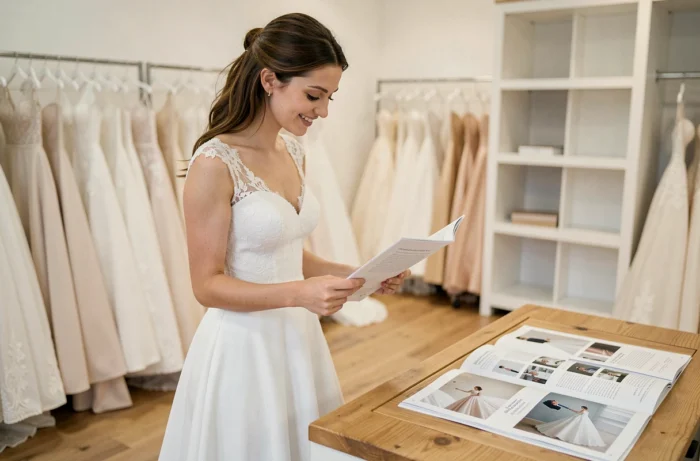
Tati’s pricing strategy in the wedding segment was based on a precise industrial logic: high order volumes, synthetic materials (polyester, heat-bonded tulle), and a short circuit without specialized retail intermediaries. Understanding this mechanism remains key to evaluating the offers that today claim this heritage, notably through the Tati wedding catalog 2025, which lists the models still available at reduced prices.
Materials and Craftsmanship of Tati Wedding Dresses: What the Price Really Reflects
A wedding dress sold for under 400 euros almost systematically uses microfiber polyester or synthetic satin. The tulle is often heat-bonded rather than sewn edge to edge, which reduces assembly time but limits durability.
We observe that the main difference with a designer dress is not in the immediate visual appearance, but in the interior finishing. The reinforcement seams at the bodice, the quality of the boning, and the type of lining (simple veil or opaque lining) vary significantly from one model to another, even within the same catalog range.
On models like “Balanquin” or “Papillon,” referenced in the old Tati catalog, the cut is based on a standardized pattern available in a few sizes. Customization does not exist: one must budget for alterations, often underestimated, which can represent a significant portion of the initial purchase price. To spot models still available at reduced prices, the Tati wedding catalog 2025 serves as a useful starting point.

Cheap Wedding Dress in 2025: Alternatives to the Classic Tati Model
The low-cost wedding dress market has fragmented. Three channels are now competing for the clientele that Tati captured alone a few years ago.
- Structured second-hand: specialized platforms and physical clearance stores offer dresses worn only once, with significant discounts. Buying second-hand is becoming a common reflex, focused on the traceability of the model and the actual condition of the dress rather than just the entry price.
- Rental with included alterations: some retailers now include adjustments in the rental price, which radically changes the comparison between catalog prices and total actual costs. A rented and altered dress can end up being cheaper than a new low-priced dress, then adjusted by an independent seamstress.
- Capsule collections from French brands positioned in the eco-responsible niche, offering models at controlled prices by limiting intermediaries and working with recycled or certified materials.
Fast Fashion Regulation and Impact on Ultra-Discount Dresses
France has adopted a law explicitly targeting ultra-fast fashion, with per-item fees coming into effect in September 2026. This regulatory framework directly impacts the very cheap dresses sold online, those that compete with the ultra-discount wedding segment.
In practical terms, models imported at very low cost now bear a regulatory surcharge that reduces the price gap with traditional channels. Online sales platforms are adjusting their pricing grids, and some references are simply disappearing from catalogs.
For future brides looking for a dress under 500 euros, this evolution changes the game. The displayed price is no longer sufficient: one must factor in delivery fees, any additional taxes, and the cost of alterations to obtain the total actual cost.
Total Actual Cost of a Budget Wedding Dress
We recommend thinking in terms of “carried cost” rather than catalog price. Here are the items to add up:
- Purchase or rental price of the dress
- Alterations (hem, bodice adjustment, strap placement): an item that varies greatly depending on the complexity of the model
- Accessories included or not (petticoat, veil, belt)
- Post-ceremony cleaning if resale is planned
On a Tati model or equivalent, alterations often represent the most underestimated item. A poorly fitted bodice on a standardized pattern may sometimes require a complete redo, which negates the savings made at purchase.
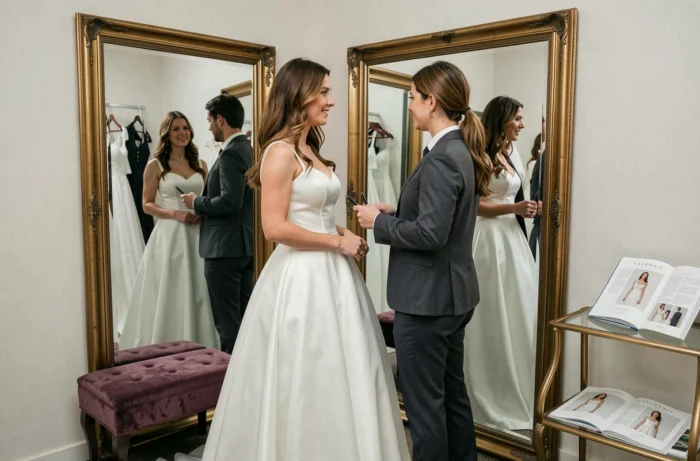
Physical Wedding Dress Shops: A Network Under Pressure
The physical market of specialized shops is going through a tough time. Closures are reported in several French cities, with a recurring observation: fixed costs (rent, stock, qualified personnel) are no longer compatible with the pricing pressure exerted by e-commerce.
This contraction of the physical network has a direct consequence for budget-conscious buyers. Fewer shops mean fewer fitting opportunities, which pushes toward online purchasing, where the risk of incorrect sizing or disappointment with the material is higher.
The shops that survive are betting on second-hand and permanent clearance, a positioning that aligns with that of the old Tati catalog: offering volume at reduced prices, with in-store fitting service.
Online Fitting and Purchase: Technical Precautions
Ordering a wedding dress without trying it on requires knowing your exact measurements (bust, waist, hip, back-to-floor length). Size guides from online catalogs use grids that vary from one brand to another. A size 38 from one manufacturer may correspond to a size 40 from another.
Checking the return policy before ordering remains the only reliable safety net. Some platforms do not accept returns of wedding dresses, or apply restocking fees that significantly reduce the financial interest of the operation.
The Tati wedding catalog 2025 remains a relevant entry point to identify models at controlled prices, provided one does not stop at the displayed price. The real savings come from the total carried cost, the choice of purchasing channel, and the ability to anticipate necessary alterations on a standardized cut.