
A leaking faucet on a Sunday evening, a shelf to fix before a large package arrives, a switch to replace after a power outage: you don’t choose when DIY is necessary. What makes the difference between a quick repair and half a day wasted is rarely the know-how. It’s the tools available at hand, and especially their compatibility with the task at hand.
Tool Compatibility with Your Materials: The Real Selection Criterion
Buying a drill without checking the nature of your walls is like choosing tires without knowing the car. A drywall wall, a load-bearing concrete wall, and a hollow brick partition require different drill bits, power, and types of anchors.
Before any purchase, take stock of the materials present in your home. Concrete blocks, wood, metal, plaster: each surface requires a specific consumable. Choosing drill bits and attachments based on what you have prevents duplicate purchases and accessories that end up at the bottom of a drawer.
The same logic applies to batteries. If you already own a cordless tool from a particular brand, check that your next purchase uses the same battery system. Major brands offer ranges where one battery powers multiple devices. This saves space, budget, and charging time. You can also compare the equipment offered by Oh Brico to identify compatible tools before placing an order.

Minimal DIY Kit: Starting from a Small Base and Upgrading
The strong trend in consumer tools is moving away from all-in-one kits in favor of a small base that grows with each project. You start with the bare essentials and then invest when a concrete project demands it.
The Essential Manual Base to Have at Home
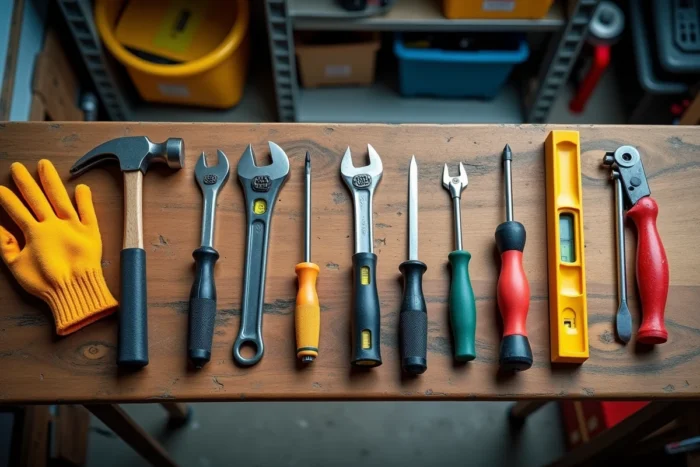
- A carpenter’s hammer (not too heavy; the balance between the head and the handle matters more than the raw weight) for nails, stubborn anchors, and small adjustments
- A set of flat and Phillips screwdrivers, ideally with an ergonomic handle to reduce fatigue during prolonged screwing
- A combination pliers and a cutting pliers, sufficient for common plumbing and small wiring tasks
- A rigid tape measure of at least three meters and a compact spirit level, because a crookedly placed piece of furniture is always noticeable
The Drill/Driver as the First Power Tool
The cordless drill/driver covers the majority of common tasks: mounting shelves, assembling flat-pack furniture, drilling into wood or drywall. It’s the first power tool to acquire and often the only one for several months.
Opinions vary on the necessary power, but for standard home use, a model with variable speed and adjustable torque is more than sufficient. The purchase of a jigsaw or sander is only justified when a cutting or finishing project truly arises.
Electrical Safety and Protection: The Reflexes Before Every Job
People often think of goggles and gloves, but rarely of the electrical panel. Turning off the power at the circuit breaker and checking for the absence of voltage before any intervention on a switch, outlet, or light fixture is not generic advice. It’s a prerequisite that prevents electrocution.
A non-contact voltage tester is inexpensive and fits in a pocket. It detects the presence of current through the insulation of a cable. For someone without electrical training, it’s the most underestimated safety tool.
Personal Protection Suitable for the Job
Protective equipment is not interchangeable from one job to another. Sanding a wall generates fine dust that requires a filtering mask, not just a simple surgical mask. Cutting metal requires anti-splash goggles and cut-resistant gloves.
- Minimum FFP2 dust mask for sanding, cutting sheets, or painting work in confined spaces
- Wrap-around safety glasses for cutting, drilling into stone, and using rotary tools
- Gloves suitable for the task: leather for handling, nitrile for painting and chemicals
Ergonomics and Durability: What Differentiates a Tool That Lasts Ten Years
The purchase price tells only part of the story. A soft-handled screwdriver absorbs twisting better than a low-end rigid model. On a twenty-minute screwing task, the difference is felt in the wrist.
The comfort of grip determines the quality of the action, especially for beginners who compensate for a lack of technique with excessive effort. A tiring tool leads to sloppy finishes or forcing in the wrong place.
The availability of accessories and spare parts also matters. A sander for which compatible sanding sheets are no longer available becomes useless in two years. Before buying a power tool, check that its consumables are common and easy to source.
Minimal Maintenance for Maximum Lifespan
Storing hand tools in a dry place after each use seems obvious, but rust on a saw blade or screwdriver bit remains the primary cause of premature replacement. A quick wipe with a dry cloth and storing away from moisture is sufficient for most hand tools.
For power tools, cleaning the ventilation grilles and checking the condition of the chuck after each extended session preserves the motor. Lithium-ion batteries should ideally be stored between one-quarter and three-quarters charged, never fully drained for several weeks.
An effective DIY workshop isn’t built in a single trip to the store. You start with a solid manual base, add a drill/driver suitable for your walls, and complete it over time with real projects. The last point not to overlook: every tool deserves a fixed storage place. Knowing where to find your combination pliers at midnight is what turns an emergency into a simple formality.