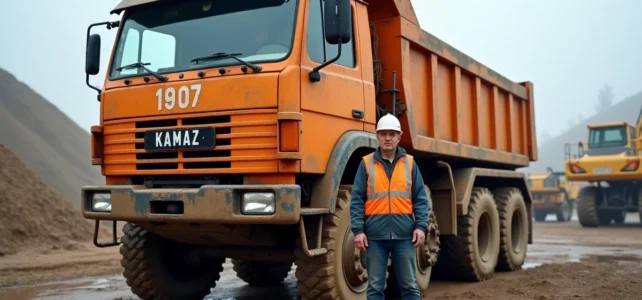
On a logging site in Siberia or a lateritic track in sub-Saharan Africa, the choice of truck is not discussed in the same way as in European logistics. When the road disappears, when temperatures fluctuate between extremes, Russian utility vehicles occupy a niche that few Western manufacturers address directly. KAMAZ, GAZ, Ural: these names come up consistently whenever we talk about transport in degraded conditions.
Russian utility vehicles and terrain constraints: what changes the game
A carrier operating on unpaved routes is looking for something different than a highway logistician. The priority is ground clearance, chassis robustness, and the ability to drive with minimal maintenance infrastructure. Russian trucks have been designed to meet exactly these specifications.
KAMAZ, for example, produces heavy trucks designed for the harshest environments, including off-road and extreme weather conditions. The complete range can be found on www.kamaz.fr, which details the models available for the professional market.
What distinguishes these vehicles is a design philosophy focused on repairability. Mechanical parts are often standardized, and electronic systems remain accessible without complex proprietary tools. In the field, this means that a local mechanic can intervene without waiting for a certified technician for three weeks.

KAMAZ trucks: performance and reliability on difficult tracks
KAMAZ is the leading truck manufacturer in Russia. The company has built its reputation on vehicles capable of handling heavy loads in conditions where most competitors decline. The all-terrain models with all-wheel drive form the core of the offering for professionals in construction, mining, and transport in remote areas.
All-wheel drive and reinforced axles are the foundation, not an option. On a muddy track with a load of several tons, this makes the difference between reaching the destination and getting stuck.
Diesel engines and terrain consumables
The diesel engines of KAMAZ are designed to operate with fuels of varying quality, a daily reality in some operating regions. This mechanical tolerance reduces the risk of breakdowns related to fuel supply.
One point to watch: like all modern diesel trucks, these vehicles incorporate SCR pollution control systems that require AdBlue. The global market for this urea solution represents over $35 billion and continues to grow, reflecting the structural dependence of diesel fleets on this consumable. Planning a stock of AdBlue at isolated logistics bases avoids costly immobilizations.
GAZ and Ural: other Russian brands for specific uses
The Russian automotive industry is not limited to KAMAZ. GAZ produces light and medium utility vehicles, often used for distribution in rural areas or personnel transport. GAZ models are positioned in a lighter segment, suitable for moderate loads and frequent trips.
The Ural trucks, on the other hand, compete with KAMAZ in the all-terrain segment. Their historical specialty is crossing: portal axles, generous ground clearance, high fording capability. They are found in forestry and operations in mountainous terrain.
- KAMAZ: versatile heavy trucks, from construction sites to long-distance transport on tracks, with a wide range of tonnages
- GAZ: light to medium utility vehicles, suitable for local distribution and mixed goods-personnel transport
- Ural: specialist in extreme crossing, favored for forestry, military, and off-road areas
Each brand covers a specific segment, and confusing them leads to purchasing errors. A GAZ will not replace a KAMAZ on a mining site, just as an oversized Ural makes no sense for urban delivery.

European regulations and Russian utility vehicles: what to anticipate
Operating Russian utility vehicles in Europe or internationally requires navigating a changing regulatory framework. Starting July 1, 2026, certain light utility vehicles used for international goods transport will need to be equipped with a tachograph and comply with European social regulations on driving and rest times.
This obligation, which previously mainly concerned heavy trucks, now extends to light commercial vehicles in international transport. For a professional using GAZ utility vehicles in cross-border operations, this means an additional investment in onboard equipment and training drivers on the new rest time rules.
Certification and spare parts in the European market
Access to spare parts remains a determining factor. In the Russian market and in CIS countries, the distribution network is dense. In Western Europe, feedback varies on this point: some operators report acceptable supply times via specialized importers, while others prefer to build a preventive stock of wear parts.
- Check compliance with current Euro emission standards in the country of operation
- Anticipate the installation of a digital tachograph for any use in international transport within the EU
- Identify an importer or distributor of spare parts before purchase, not after the first breakdown
A robust truck poorly supplied with parts costs more than a regular truck well maintained. The legendary mechanical reliability of Russian vehicles does not exempt from structured spare parts logistics, especially outside their home market.
The choice of a Russian utility vehicle for professional use is justified by a robustness-price ratio that is hard to match in all-terrain and extreme conditions segments. The question is not whether these trucks can handle the road, but whether the ecosystem around them (parts, regulations, training) is in place before turning the key in the ignition.