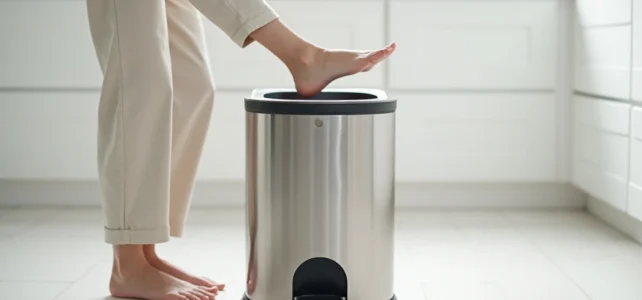
You press the pedal, the lid lifts, you throw your waste without touching anything. The action seems simple, almost trivial. However, the pedal bin relies on a precise mechanical assembly, where each part plays a role in the smooth opening and closing of the lid.
Lever, rod, and spring: the mechanics hidden under the pedal
The basic principle is that of a class 2 lever. When the foot presses the pedal, it pivots around an axis fixed at the bottom of the bin. This movement pulls a metal rod (called a rod) down or back.
The rod transmits the force to an articulated arm connected to the lid. This arm pushes the lid upwards. The entire chain operates without a motor or battery, solely through mechanical transmission.
The return to the closed position depends on the type of return mechanism used. On most models, a helical spring brings the rod and the lid back to their initial position as soon as the foot releases the pedal. Some models incorporate a hydraulic or pneumatic damper that slows the descent of the lid for a silent closure, often referred to as “soft close.”
To better understand the opening mechanism of a bin on Maisons Alternatives, it should be noted that the quality of the rod and the spring determines the longevity of the whole. A thin or misaligned rod eventually bends, making opening laborious.
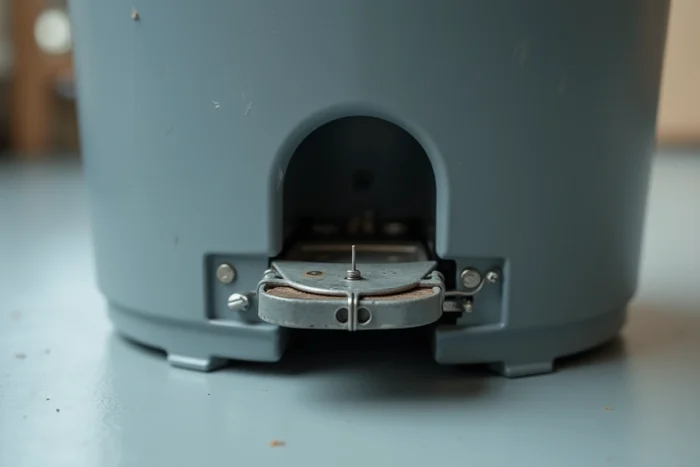
Built-in pedal or external pedal: two designs, two durabilities
You may have noticed that on some bins the pedal protrudes significantly from the body, while on others it barely flushes? This design choice affects the durability of the mechanism over time.
Classic external pedal
The pedal is fixed on the outside, connected to the rod by a visible joint. This system is easy to repair or replace. However, the exposed rod can get caught on a chair leg or a broom, which gradually deforms it.
Built-in pedal within the bin body
The built-in pedal protects the rod from shocks and snags. The mechanism is housed behind the wall or in the base. Recent models made from reinforced plastic use this principle to reduce the risk of injury and limit mechanical wear. The downside: in case of breakage, replacing internal parts sometimes requires disassembling part of the chassis.
Pedal, sensor, or manual lid: which opening system to choose in the kitchen
The pedal is not the only opening mode available. Infrared sensor bins and manually tilting lid models are also featured in catalogs. Each system meets different constraints.
- Mechanical pedal: no power supply needed, reliable opening even with wet or gloved hands. The best compromise between hygiene and durability for intensive kitchen use.
- Infrared sensor: contactless opening, but dependent on batteries or a rechargeable battery. More prone to malfunctions, and the sensor can be triggered accidentally if an animal or object passes in front of it.
- Manual lid (push or tilting): the cheapest system, but the hand touches the surface directly, which poses a hygiene issue, especially during food preparation.
Recent buying guides confirm that the pedal remains the best compromise for hygiene and reliability for daily use, far ahead of the sensor in terms of longevity.
Maintaining the pedal mechanism: extending lifespan without forcing
The primary cause of breakage in a pedal bin is not the natural wear of the spring. It is a sudden action on the pedal when the lid is stuck, due to a jammed bag or an object in the way. Never force the pedal if the lid resists: first lift the lid by hand to clear the obstruction.
The removable inner bucket, an ally of the mechanism
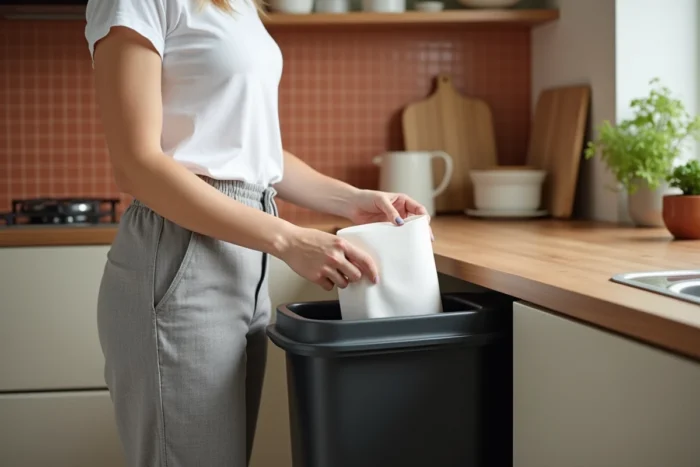
Many current models incorporate a removable bucket with a handle. Its role goes beyond simple cleaning comfort. When you change the trash bag, lift the bucket instead of pulling the bag through the opening while keeping the pedal pressed down. This habit avoids putting prolonged strain on the lever and the spring, which reduces mechanical fatigue on the rod and the spring.
Cleaning and lubrication
On stainless steel models, clean the surface with a soft cloth and a product suitable for stainless steel, then wipe with a dry cloth to avoid streaks. For the mechanism itself, a drop of petroleum oil on the pivot points of the rod once or twice a year is enough to maintain smooth operation.
- Regularly check that the rod is not bent or misaligned.
- Check the return spring: if it no longer fully returns the lid, it is probably relaxed and needs to be replaced.
- On models with silent closure, the damper may lose effectiveness after several years. Some manufacturers offer replacement parts for this specific component.
Pedal bin and waste sorting: adapting the mechanism to the room
In the kitchen, the volume and frequency of use guide the choice. A double compartment model allows for separating recyclable waste without multiplying bins, but the pedal mechanism then operates a wider lid, which increases the strain on the rod.
In a bathroom or office, a compact model with a built-in pedal is more suitable. Design also matters: manufacturers offer finishes in wood, brushed metal, or matte colors so that the bin integrates with the surrounding furniture without clashing.
Choosing the right bag size prevents plastic from getting stuck in the mechanism. A bag that is too large rises between the bucket and the lid, while a bag that is too small slips to the bottom and requires reaching in to retrieve it. Manufacturers generally indicate the compatible bag size on the product sheet.
The operation of a pedal bin relies on three parts that work together: the pedal, the rod, and the spring. Protecting these parts from unnecessary strain, using the removable bucket when changing the bag, and not forcing when the lid resists are the three reflexes that can extend the mechanism’s lifespan far beyond what most users imagine.