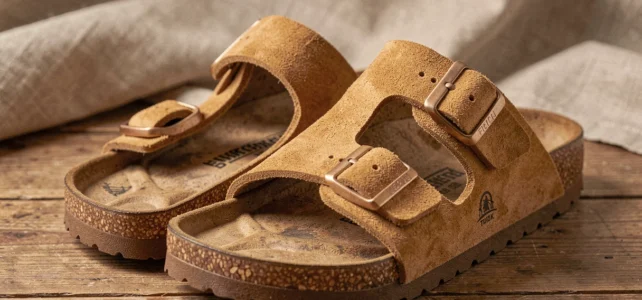
A pair of Birkenstocks often costs two to three times more than a mass-market sandal. The price displayed in the window can be surprising, sometimes even annoying. Yet, the German brand continues to increase its sales year after year, with revenue exceeding one billion euros. Understanding this price requires looking beneath the surface, at the manufacturing, commercial strategy, and positioning in the accessible luxury market.
Cork sole and German manufacturing: what the price of a Birkenstock conceals
Have you ever compared the weight of a Birkenstock with that of a low-end sandal? The difference is immediately noticeable. The insole combines natural cork and latex, two materials that are more expensive than the synthetic foam used by most competitors.
This cork is not just simple padding. It gradually deforms to fit the shape of the foot, which explains why many wearers describe increasing comfort over the weeks. The upper part, made of leather or Birko-Flor (a synthetic material developed in-house), undergoes several quality control stages before assembly.
The majority of production remains localized in Germany, where labor costs are significantly higher than in countries where most mass-market shoes are made. This industrial choice directly impacts the final price.
A pair assembled in Southeast Asia with equivalent materials would be cheaper to produce, but Birkenstock maintains this European base as a guarantee of quality. To better understand why Birkenstocks are so expensive, one must also look beyond the workshop.

Organized scarcity: the distribution strategy that protects Birkenstock prices
Where manufacturing explains part of the cost, the commercial policy explains why this cost rarely decreases. Birkenstock applies what its management calls “engineered distribution”: deliberately limiting supply by market, channel, and model.
In practical terms, the brand restricts the quantities sent to retailers. It selects authorized points of sale. It decides which colors and sizes are available in each country. This control prevents resellers from slashing prices to clear excess stock.
The result is measurable: over 90% of sales occur at the catalog price, according to stock market analyses published in 2026. In the shoe industry, this figure is exceptionally high. Most competing brands generate a much larger portion of their revenue during sales or through promotions.
No massive promotions, even during sales
You won’t find Birkenstocks at -50% on the official website. The brand strictly regulates the discounts that its partners can apply. Some occasional markdowns exist at certain online resellers, but they remain marginal and often concern end-of-line models.
This pricing discipline has a direct psychological effect. A product that is rarely discounted is perceived as more desirable. Organized scarcity creates a demand that remains higher than supply, giving Birkenstock a pricing leverage that few sandal brands possess.
Birkenstock between fashion and orthopedics: a positioning that justifies the price
For a long time, Birkenstock was associated with orthopedic shoe stores. The brand has existed for over two centuries. Its shift towards mainstream fashion has accelerated in recent years, driven by collaborations with luxury houses and an increasing presence in fashion shows.
This dual positioning, between medical comfort and fashion accessory, is the key to pricing. A sandal that claims to be only “trendy” eventually goes out of style. A sandal that is only “orthopedic” remains confined to a niche market. Birkenstock occupies both spaces simultaneously.
What the brand sells beyond the sandal
When a consumer buys an Arizona or a Boston, they are also paying for:
- An above-average longevity, as cork and leather age beautifully instead of degrading quickly, which reduces the cost per year of use
- An anatomical foot support designed from the orthopedic expertise accumulated by the brand since its inception
- A social signal associated with a certain lifestyle, balancing casualness and displayed purchasing power
This last point is not trivial. The high price itself contributes to the perceived value of the product. Lowering prices would dilute the brand image, a risk that management refuses to take.

Counterfeits and resale: indicators of the Birkenstock brand power
A good indicator of a brand’s strength is the counterfeit market that develops around it. Fake Birkenstocks circulate massively online, especially on Asian marketplaces. The brand invests in combating these copies, which represents an additional cost reflected in the price.
Counterfeiting confirms that demand far exceeds official supply. If the product did not have this appeal, no one would bother to copy it. The second-hand resale market reflects the same dynamic: some sold-out models resell for prices close to new.
The weight of stock market listing
Since its IPO, Birkenstock has been under pressure from investors who expect high margins and steady growth. Management has raised its revenue forecasts for 2026, driven by strong demand across all its markets, including France.
This financial pressure reinforces the logic of high prices. Lowering prices might improve volumes in the short term, but would erode the margins that shareholders demand. Birkenstock’s business model relies on the unit value of each pair sold, not on volume.
The price of a Birkenstock is therefore neither an accident nor a marketing whim. It reflects a coherent chain of decisions: European manufacturing with expensive materials, deliberately restricted distribution, refusal of massive promotions, and hybrid positioning between orthopedics and fashion. As long as demand remains higher than supply, the brand has no reason to lower its prices.