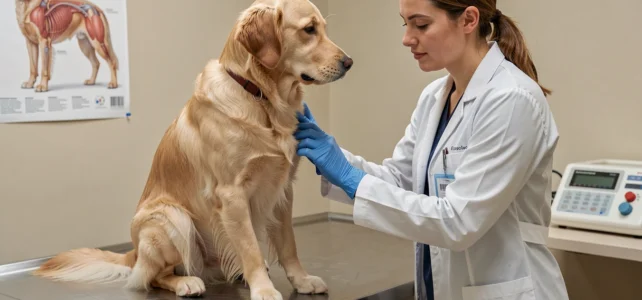
The anal gland abscess in dogs results from a specific sequence: obstruction of the excretory canal, accumulation of secretions, bacterial proliferation, and then the formation of a purulent pocket. Understanding this mechanism allows for the distinction between a simple engorgement and an infection that requires prompt management. Several factors promote this cascade, and not all are equal in terms of severity or frequency.
Engorgement, infection, and abscess: three stages not to confuse
Articles on the subject often mix these terms. However, they correspond to distinct stages, with different implications for treatment.
| Stage | What happens | Visible signs | Urgency |
|---|---|---|---|
| Engorgement (impaction) | The anal sac does not empty during defecation, secretions accumulate and thicken | Sledding sign (the dog rubs its rear end on the ground), licking of the perianal area | Consultation recommended within a few days |
| Infection (sacculitis) | Bacteria colonize the stagnant contents, the fluid becomes purulent | Warm swelling on one side of the anus, pain during defecation, sometimes fever | Consultation within 24 to 48 hours |
| Abscess (then fistula) | The pressure of the pus distends the sac, which may rupture through the skin | Red-violet swelling, bloody or purulent discharge, marked pain | Veterinary emergency |
When the swelling is warm, and the discharge becomes bloody or purulent, the anal sac abscess must be treated as a veterinary emergency. The transition from engorgement to abscess can take only a few days if no intervention occurs.
To better identify the causes of anal gland abscess in dogs and the appropriate solutions, it is essential to first understand what blocks the natural drainage.
Triggering factors for anal sac obstruction in dogs
An abscess is always the result of prolonged obstruction. The causes of this obstruction fall into two categories: mechanical and systemic.
Mechanical causes
The consistency of the stools plays a direct role. Soft or irregular stools do not adequately compress the anal sacs during passage, preventing their natural drainage. Dogs fed a low-fiber diet or suffering from chronic diarrhea are therefore more exposed.
Morphology also comes into play. Small breed dogs are more often affected by anal gland infections than larger breeds. Their excretory canals, being narrower, are more easily blocked. The German Shepherd is a notable exception among large breeds, with a recognized predisposition to anal sac conditions.
Systemic causes
Food or environmental allergies cause local inflammation that thickens secretions and narrows the drainage canal. This factor is often underestimated. Prevention of recurrences increasingly relies on identifying the underlying cause, particularly allergies and digestive disorders, rather than on repeated manual drainages.
Obesity reduces perianal muscle tone and alters the pressure exerted on the sacs during defecation. An overweight dog thus accumulates both a mechanical and a metabolic factor.
- Soft stools or recurrent diarrhea: insufficient compression of the anal sacs during defecation
- Food allergies or atopy: local inflammation that thickens the contents of the sacs and obstructs the canals
- Morphology (small breeds, German Shepherd): narrower excretory canals or genetic predisposition
- Overweight: decreased perianal muscle tone and alteration of defecation mechanics
Surgical drainage and veterinary treatment of anal abscess in dogs
At the stage of engorgement, a manual drainage performed by a veterinarian is usually sufficient. The professional applies controlled pressure to the sacs to expel the thickened contents.
When the infection is established, antiseptic washing of the sac cavity is necessary, along with local or systemic antibiotic therapy depending on the severity. The veterinarian may also prescribe an anti-inflammatory to relieve pain.
At the abscess stage, especially if it is ruptured or about to rupture, surgical drainage with cavity cleaning is the standard treatment. The veterinarian incises the pocket, evacuates the pus, irrigates the area, and implements an appropriate antibiotic treatment. An Elizabethan collar is often necessary to prevent the dog from licking the wound.
Removal of anal sacs in case of recurrence
When abscesses recur despite proper treatment and correction of predisposing factors, surgical removal of the anal sacs (sacculectomy) becomes the reference option. This intervention permanently eliminates the problem, but it carries a risk of injury to the anal sphincter. The veterinarian assesses this benefit-risk ratio on a case-by-case basis.
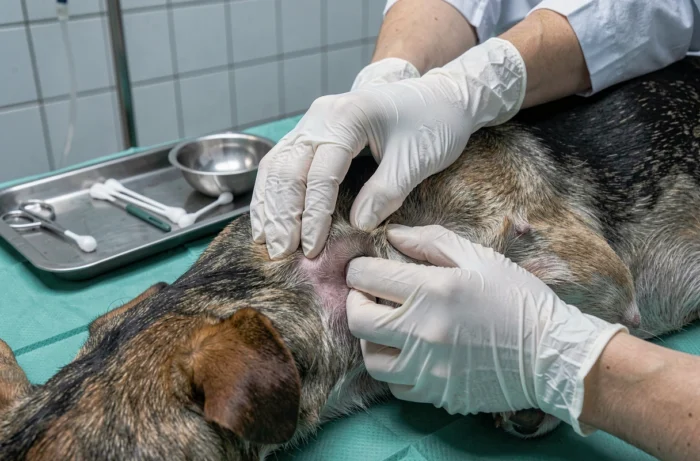
Home manipulation of anal glands: the real risks
Many tutorials show how to empty a dog’s anal glands at home. This practice carries real risks if it has not been taught by a veterinarian during a consultation demonstration.
An untimely or poorly directed expression can worsen inflammation or even rupture an already infected sac. The purulent content then spreads into the surrounding tissues, turning a localized infection into perianal cellulitis, which is significantly more complex to treat.
- Risk of rupture of an infected sac if pressure is poorly applied or exerted on weakened tissue
- Worsening of inflammation due to repeated manipulation without medical indication
- Delay in diagnosis: a drainage that seems to “work” may mask an ongoing developing infection
Systematic preventive drainage, without signs of engorgement, is also being questioned. It can irritate the canal lining and paradoxically promote future obstructions.
The most reliable reflex remains observation. A dog that rubs, excessively licks its anus, or shows discomfort during defecation should be examined by a veterinarian before any manipulation. Early identification of engorgement prevents progression to abscess in the vast majority of cases.