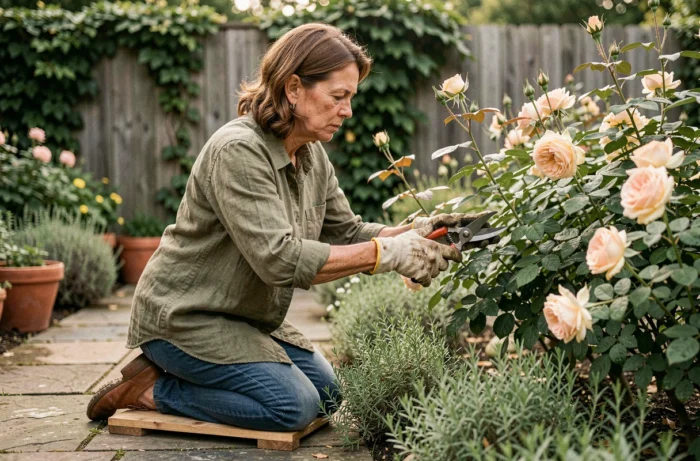
A yellowed lawn in August, roses that are struggling in April, shrubs pruned at the wrong time: these situations almost always reveal a mismatch between maintenance actions and the actual rhythm of the garden. Successfully maintaining your garden year-round relies less on the amount of work and more on the right action at the right time, tailored to what the soil and plants truly require.
Watering Restrictions: What It Means for Your Garden
Before discussing gardening techniques, we must acknowledge a constraint that has become permanent. Since the summer of 2026, the majority of French departments have experienced water use restrictions. In July 2026, 84 departments had at least one municipality under restriction according to the official VigiEau tool.
In practice, watering lawns and ornamental gardens is often prohibited between 8 AM and 8 PM. In times of drought crisis, watering ornamental gardens may be completely banned, even at night. Vegetable gardens are generally still allowed, but with strict conditions: reduced hours, watering with a watering can at the base of the plants.
This reality forces a rethinking of garden maintenance. Watering less but better is no longer just magazine advice; it’s a legal obligation. To find information on the Conseil Jardinage website, you can follow the evolution of these regulations, which vary from one department to another.
Have you noticed that a mulched soil stays cool much longer than bare soil? This is the first lever for adaptation. An organic mulch of a few centimeters (dead leaves, chipped branches, straw) reduces evaporation and significantly spaces out watering. In a vegetable garden, this technique makes the difference between soil that dries out in one day and soil that stays moist for three to four days.
Living Soil and Natural Fertilization: The Foundation of an Autonomous Garden
Most maintenance guides start with pruning or mowing. Soil takes a back seat. This is a priority mistake. Healthy soil nourishes plants without constant intervention, limits diseases, and retains water better.
Understanding What Happens Below the Surface
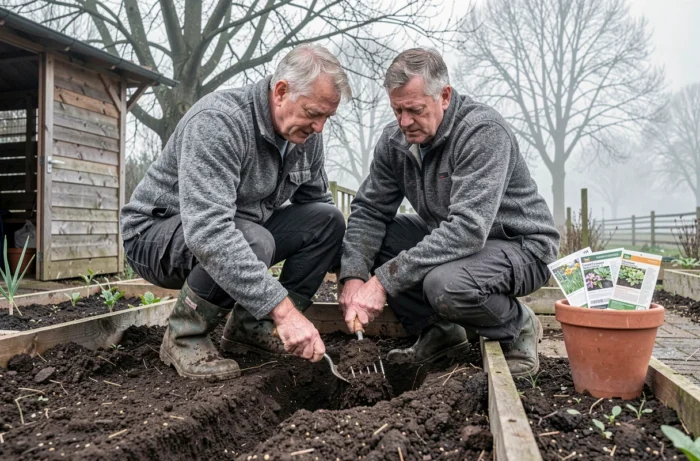
Garden soil functions like an ecosystem. Earthworms, microscopic fungi, and bacteria decompose organic matter and transform it into nutrients that roots can absorb. When you till the soil deeply every year, you disrupt this network.
Not tilling systematically protects soil life and its structure. Prefer a simple surface scratching in spring to loosen the top few centimeters. Tools with teeth (broadfork, rake) aerate without turning over the layers.
Compost and Mulch as Base Fertilizers
Homemade compost remains the best amendment for a garden. Peels, grass clippings, dead leaves: these waste materials become a rich soil in a few months that you spread at the base of shrubs and on the vegetable garden.
- In autumn, place a layer of semi-mature compost on the empty plots of the vegetable garden. Soil organisms will decompose it over the winter.
- In spring, add well-matured compost (dark, odorless) around nutrient-hungry plants like tomatoes, zucchinis, and roses.
- In summer, mulch takes over: it nourishes the soil as it decomposes slowly while limiting evaporation.
This approach gradually makes the garden more autonomous. After two or three years of this cycle, the soil retains water better and plants require less fertilizer.
Pruning Shrubs and Lawn Care: The Most Common Timing Mistakes
Pruning at the wrong time is probably the most common mistake. A forsythia pruned in autumn will not bloom in spring because its flower buds form on last year’s wood. A hydrangea cut back in March in a region with late frosts will struggle to regrow.
The basic rule is simple. Spring-flowering shrubs should be pruned just after they bloom, never before. Summer-flowering shrubs (buddleia, hibiscus) should be pruned in late winter, before new growth begins.
For lawns, regular mowing matters more than cutting it short. Cutting too short weakens the root system and encourages weeds. Maintain a sufficient cutting height, especially in summer when heat stresses the lawn.
Weeding: What Is Allowed and What Is Not
Glyphosate has been banned for individuals for several years. Synthetic chemical herbicides have largely been removed from the consumer market. Manual weeding, thermal weeding (with a flame weeder), or preventive mulching remain.
White vinegar is often presented as a natural alternative. Its use as a herbicide is not approved in France. It destroys the aerial part of plants but does not affect the roots, and it acidifies the soil over time.
- Manual weeding in spring, when the soil is moist, is the most effective: the roots come out whole.
- Thick mulching (at least five centimeters) prevents most weeds from germinating.
- False sowing, which involves preparing the soil and then waiting for weeds to sprout before destroying them and sowing, limits later weeding in the vegetable garden.
Preparing for Winter Without Overprotecting Plants
The temptation to wrap everything in frost cloth as early as November is strong. Most plants suited to your climate do not need it. Protect only plants sensitive to frost (potted citrus, Mediterranean plants, young plantings from the year) is sufficient in most French gardens.
The real winter work lies elsewhere. Rake fallen leaves off the lawn to prevent smothering, but leave them at the base of hedges and flower beds: they provide shelter for beneficial insects and serve as natural mulch. Clean and sharpen your pruning tools. A clean pruner limits the transmission of diseases from one shrub to another.
Winter is also the best time to observe the structure of your garden. Without foliage, you can spot dead branches, shape imbalances, and shaded areas that could host plants suited for the following spring.
A well-maintained garden year-round does not require more work. It demands actions taken at the right time, soil that is nourished rather than exhausted, and attention to the regulatory constraints that now govern the use of water and phytosanitary products. The garden calendar is built according to what the land and weather dictate, not a theoretical schedule that is the same everywhere.