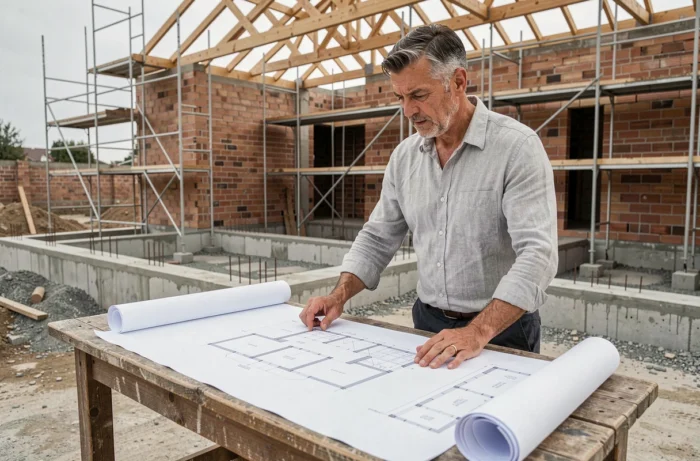
The waterproofing in VEFA triggers one of the heaviest payment calls in the off-plan purchase calendar. This stage, often reached several months before delivery, corresponds to the moment when the roof protects the building from the elements. Understanding what is technically and financially at stake at this stage allows for better anticipation of payments and a response in case of delays.
VEFA Payment Calls: Distribution by Construction Stage
The financing of a VEFA purchase follows a legal schedule. Each technical stage of the construction allows the developer to request a fraction of the total price. The table below summarizes the correspondence between the progress of the work and the payment ceiling.
| Construction Stage | Cumulative Price Ceiling | What This Covers |
|---|---|---|
| Completion of Foundations | 35% of the price | Excavation, base, foundation slab |
| Waterproofing | 70% of the price | Raising of load-bearing walls, framework, waterproof covering |
| Completion of the Building | 95% of the price | Finishing work completed, fittings installed |
| Delivery | 100% of the price | Handing over the keys after any reservations have been lifted |
Between the foundations and waterproofing, the developer can therefore request 35 additional percentage points in a single step. This is the most significant financial leap in the entire schedule. For buyers financing through a loan, this tranche generates significant interim interest, as the bank releases funds progressively without the capital repayment having started.
To delve deeper into the technical aspects of VEFA waterproofing on immofactory.net, the details of the work associated with each stage help verify the consistency between actual progress and the amounts requested.
Weather Certificates and Delivery Delays: What Case Law Has Changed
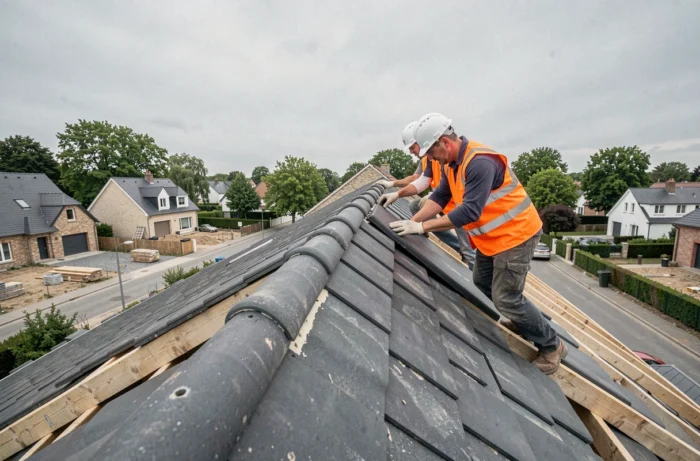
Waterproofing is directly dependent on weather conditions. Prolonged rain, frost, strong winds: these hazards delay the installation of the framework and covering. Developers then invoke delay suspension clauses to postpone the delivery date.
Two recent rulings from the Court of Cassation have tightened the conditions under which a developer can claim these delays.
- The ruling of April 30, 2025 (n° 23-21.499) requires that weather certificates be based on objective, public data that can be contested by the buyer, and not solely on the assessment of the developer’s architect.
- The ruling of May 2, 2024 (n° 22-20.477) specifies that mere slowness of the company does not constitute a “failure” suspending the deadline. A termination of the contract after formal notice is required for the delay to be valid.
- The direct consequence for the buyer: a developer who notifies a delay based on a weather certificate not supported by verifiable weather reports can now be contested more effectively in court.
Before 2024, most buyers accepted these delays without verifying them. The legal context has changed. A buyer who receives a notification of delay at the waterproofing stage has an interest in requesting the precise weather justifications on which the developer bases their claim.
Waterproofing and Airtightness: Two Distinct Technical Stages
The two terms are often associated, but they refer to different realities on the construction site. Waterproofing exclusively concerns the water tightness from the top of the building: framework, covering, and zinc work. Once the roof is installed and watertight, the major work on the upper part is completed.
Airtightness occurs afterward. It involves installing exterior joinery (windows, doors, sliding glass doors) to make the building airtight against wind and drafts. It is only at this stage that finishing work can truly begin under good conditions: interior insulation, partitions, electrical networks, and plumbing.
In VEFA, no distinct payment call is planned for airtightness. The ceiling remains set at 70% of the price until complete completion. The developer cannot therefore request an additional payment between waterproofing and the end of the finishing work.
Checking Actual Progress During a Site Visit
Developers sometimes organize site visits at the waterproofing stage. These visits allow for a visual inspection of the roof’s condition, the presence of zinc work elements, and the absence of temporary tarpaulins that would indicate an unfinished site.
During this visit, three points deserve special attention: the condition of the connections between the covering and the walls (a frequent source of future infiltrations), the presence or absence of exterior joinery (which indicates whether the site is also airtight), and the compliance of roofing materials with those described in the descriptive notice of the reservation contract.

Buyer Modifications: The Timeline to Respect Before Waterproofing
Requests for buyer modifications (TMA) must be made well before the construction reaches the waterproofing stage. Once the load-bearing structure and roof are in place, any structural modification becomes technically impossible or financially disproportionate.
TMA most often concern the relocation of partitions, the addition of electrical outlets, the change of coverings, or the modification of the layout of water rooms. The developer sets a deadline for these requests, usually several weeks before the pouring of the floor slabs. After this deadline, accepted modifications are limited to superficial finishes.
A buyer who waits for the waterproofing notification to request a plan change faces an almost systematic refusal. The right reflex is to submit requests as soon as the authentic deed is signed, and then to verify their consideration during the first site visit.
Waterproofing remains the most structuring financial and technical marker of a VEFA purchase. Between the tightening of case law on delays and the weight of the payment call at 70%, this stage concentrates the stakes that determine the future of the project for the buyer.