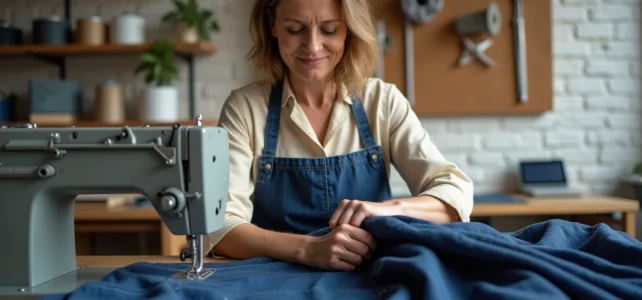
A sewing machine that struggles on double denim or breaks its needle on the third pass of faux leather presents a concrete problem of motorization, drive, and adjustment. To choose a model suitable for thick fabrics, one must compare specific technical parameters rather than rely on marketing labels. This article measures the differences between mechanical and electronic machines based on the criteria that really matter when dealing with heavy thicknesses.
Mechanical or electronic for thick fabric: the technical comparison
The debate resurfaces in every sewing forum, but the differences can be measured by objective criteria. Here is a summary table of the characteristics to observe before any purchase.
| Criterion | Mechanical machine | Electronic machine |
|---|---|---|
| Motor power | Often higher at equivalent range | Variable, depends on the model |
| Presser foot pressure | Manually adjustable on good models | Adjustable, sometimes automatic |
| Thread tension adjustment | Manual dial (direct control) | Automatic or semi-automatic |
| Presser foot lift height | Generally generous | Variable depending on the range |
| Number of stitches | Limited (10 to 30 on average) | Wide (sometimes over 100) |
| Mechanical durability | Little electronics to replace | Electronic board sensitive to wear |
On a mechanical machine, the budget is more allocated to the motor and the body than to electronics. To know which sewing machine for thick fabric suits your needs, this motor/features ratio remains the primary selection filter.
On the other hand, a high-end electronic machine like some Bernina or Juki compensates with an automatic presser foot pressure adjustment, which simplifies the transition between variable thicknesses without constant manual intervention.
Thread tension and foot pressure: the two adjustments that change everything
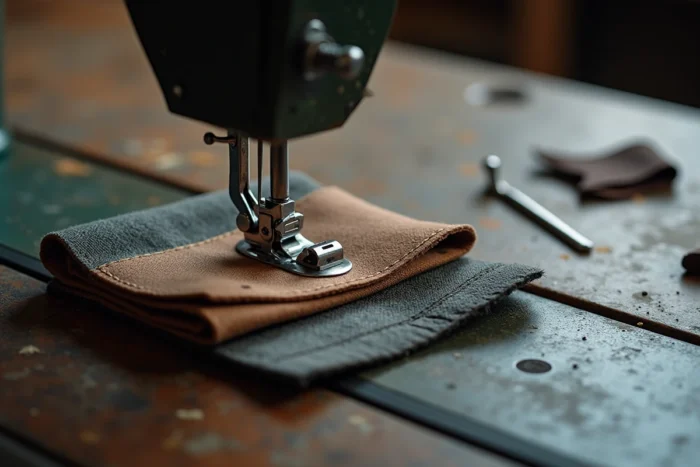
Most blockages on thick fabric do not come from a lack of raw power. They stem from improper thread tension adjustment or inadequate presser foot pressure. User feedback converges on this point: adjusting the tension and pressure matters more than the motor power.
Too much tension on multi-layer denim produces uneven stitches and unsightly puckering. Too little foot pressure allows the fabric to slip, misaligning the layers.
Testing method on fabric scraps before purchase
Recent sewing guides recommend a simple approach: test the machine on the same fabric, with the same number of layers as your actual project. Observe if the sewing follows the material without breaking the thread or distorting the fabric. This test is worth more than a technical sheet.
- Prepare a scrap of the target fabric folded in four or six layers according to your usual project
- Set the thread tension one notch below normal, then adjust gradually
- Increase the stitch length (a stitch that is too short excessively perforates dense fibers)
- Check that the feed dogs pull the fabric without you having to push
If you have to force the fabric through with your hands, the machine is not suitable, regardless of its price.
Household machines and leather: a limit to know
One point regularly comes up among repairers and professionals: household machines are not designed for continuous leather sewing. Sewing leather with a domestic machine wears out the internal mechanisms much faster than standard use. Breakdowns happen quickly.
Among the few exceptions noted in specialized feedback, some high-end Elna models can handle leather without premature damage. For regular use on genuine leather, a semi-industrial or industrial machine (like Juki) remains the most reliable choice over time.
Faux leather poses fewer mechanical problems but still requires a suitable presser foot (Teflon foot or roller foot) to prevent the material from sticking and blocking the advancement.
Selection criteria by type of sewing project
Not all thick fabrics put the same demands on the machine. Stretch denim does not require the same capabilities as bag canvas or multi-layer quilting.
Denim and thick canvas
A motor with sufficient torque and a presser foot lift height of at least 6 mm allows for crossing sewing seams without slowing down. Brother and Janome brands offer mechanical models in an accessible price range that handle these materials well.
Multi-layer quilting
Quilting requires a wide working space between the needle and the machine arm, in addition to the ability to pass through thicknesses. Models with a long arm and wide feed dogs facilitate the handling of bulky pieces. The consistency of the stitch is as important as the piercing capacity.
Bags and accessories in technical fabric
For bags, upholstery, or technical fabrics, the robustness of the metal body makes a difference. A plastic chassis vibrates more under strain and loses sewing precision. Opt for a metal body and a dual feed system.
- Metal body for stability under strain
- Interchangeable presser foot (Teflon, roller, walking) according to the material
- Suitable needles: size 90 to 110 for thick fabrics, special leather needles for faux leather
The choice of a machine for thick fabrics boils down to three technical variables: the fine adjustment capability of tension and pressure, the robustness of the body and motor, and compatibility with specialized presser feet. Testing on real fabric scraps before purchase remains the only reliable verification, far beyond what a product sheet can promise.